
- September 16, 2026
- in Blog
- by
- 39
- 0
Last Updated: September 3, 2026
When your carpet needs deep cleaning, you face a fundamental choice: steam cleaning or dry carpet cleaning. Both methods remove dirt and stains, but they work in dramatically different ways and deliver different results depending on your situation.
Steam cleaning uses hot water extraction to force pressurized water and cleaning solution deep into carpet fibers, then immediately extracts the moisture along with dissolved soil and contaminants. Dry carpet cleaning relies on very low-moisture compounds or powders that encapsulate dirt particles, which are then vacuumed away. The choice between them isn’t about which is universally “better”, it’s about matching the method to your carpet type, timeline, and specific cleaning needs.
At Stay Fresh Steam Cleaning, we help homeowners and property managers understand when each delivers the best results. Here’s what separates them and where each method actually wins.
Steam cleaning operates on a straightforward principle: inject hot water and cleaning solution into carpet fibers under pressure, then extract the liquid along with the dirt it dissolves. This process is sometimes called hot water extraction, and it’s the method most professional carpet cleaning services use as their primary deep-cleaning technique.
The equipment forces water heated to 200-300 degrees Fahrenheit into the carpet backing and pile (iicrc.org). The heat activates the cleaning solution, breaking down soil bonds and lifting contaminants away from fibers. Simultaneously, powerful suction pulls the water back out, removing up to 80% of the moisture introduced (peer-reviewed research). What remains is damp carpet that requires air circulation to dry completely.
This method excels at removing set-in stains, pet odors, and deeply embedded allergens. The combination of heat, moisture, and chemical action dissolves substances that dry methods can’t touch. If your carpet has years of accumulated soil or stubborn stains from spills and pet accidents, steam cleaning reaches places surface treatments simply can’t reach.
The trade-off is drying time. Depending on humidity, ventilation, and carpet thickness, steam-cleaned carpet typically needs 6-24 hours to dry completely. In poorly ventilated spaces or during humid weather, that window extends further.
Dry carpet cleaning takes the opposite approach: introduce minimal moisture and rely on chemical compounds to encapsulate dirt rather than dissolve it. The most common dry method uses specialized powders or solvents applied to carpet, worked into fibers with rotary brushes, then vacuumed up along with the encapsulated soil.
The process begins with application of a very low-moisture cleaning compound, often a powder containing solvents and surfactants that attract dirt particles. A rotary brush or bonnet applicator works this compound throughout the carpet pile. The solvents begin breaking down soil bonds while the powder’s absorbent properties capture particles. After 15-30 minutes of dwell time, powerful vacuuming removes the powder, the encapsulated dirt, and most of the residual moisture.
Because dry methods introduce far less water, carpet is ready for foot traffic in 1-2 hours. This matters enormously for commercial spaces, rental turnovers, and homes where you can’t afford extended downtime. The minimal moisture also eliminates the risk of mold or mildew developing if drying is incomplete, a real concern with steam cleaning in certain climates.
The limitation is depth. Dry compounds work primarily on carpet pile and surface soil. They’re effective at refreshing appearance and removing loose debris, but they don’t penetrate to the carpet backing where years of ground-in soil accumulates. For lightly soiled carpet or maintenance cleaning between deeper treatments, dry methods work well. For heavily soiled carpet or stubborn stains, they often fall short.
Drying time is one of the most practical differences between these methods, and it directly impacts your ability to use your space after cleaning.
Steam cleaning typically requires 6-24 hours before carpet is completely dry and safe for normal foot traffic (iicrc.org). In optimal conditions, warm weather, low humidity, good air circulation, you might reach walkable dryness in 6-8 hours. In winter, humid climates, or poorly ventilated rooms, expect the full 24-hour window. Complete dryness (where moisture levels return to pre-cleaning levels) can take even longer.
Dry carpet cleaning achieves foot-traffic-ready status in 1-2 hours. Most of the moisture introduced evaporates quickly because so little is applied. This speed is why many property management companies choose dry methods for rental turnovers, they can show units the same day cleaning is completed.
For homeowners, the drying time difference is significant but manageable. For commercial properties, rental turnovers, or hospitality businesses, it’s often the deciding factor. If you need your space operational immediately, dry cleaning wins. If you can wait and want maximum soil removal, steam cleaning’s longer drying time is worth the wait.
This comparison cuts across the steam-vs-dry distinction. Both methods exist in professional and DIY versions, and the gap between them is substantial.
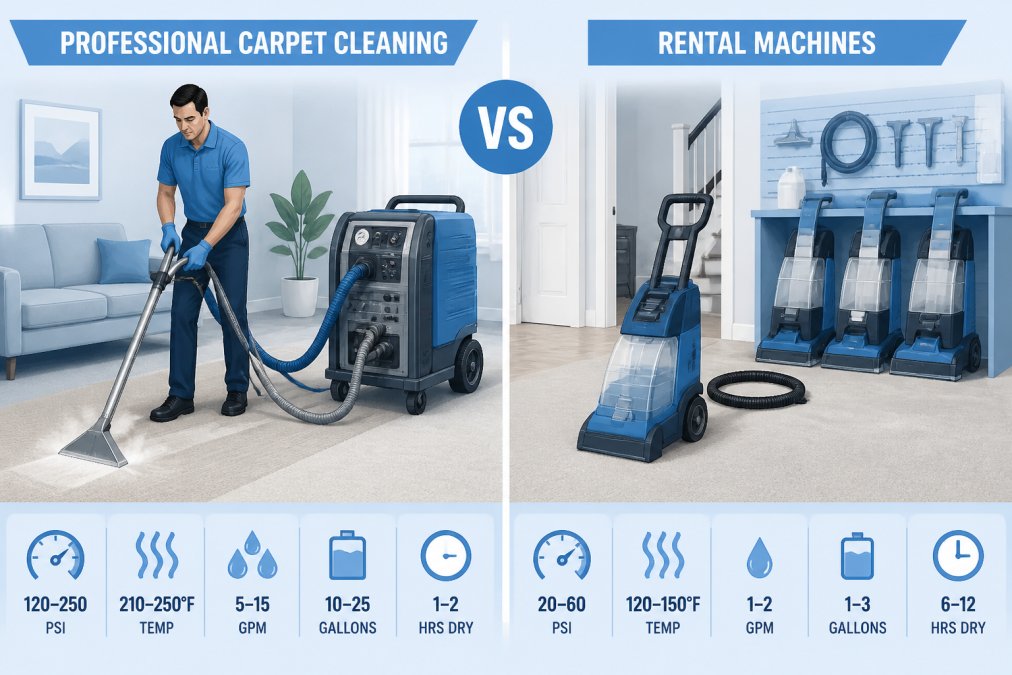
Professional equipment, whether steam or dry, operates at power levels far beyond consumer machines. Professional steam extraction equipment uses industrial-grade motors that generate 200+ PSI of pressure and suction power measured in cubic feet per minute that rental machines can’t match. The heating systems reach consistent temperatures that smaller machines struggle to maintain. Professional technicians also have training in pre-treatment, dwell times, and extraction sequences that maximize results.
When you rent a machine from a grocery store or equipment rental center, you’re getting consumer-grade equipment. A Rug Doctor Pro Deep rental machine (available at many retail locations) offers decent extraction capability compared to consumer upright cleaners, but it still operates at a fraction of professional power. Setup, operation, and cleanup also fall entirely on you, mistakes in water temperature, solution concentration, or extraction technique are common and reduce cleaning effectiveness.
The cost difference is real but context-dependent. A rental machine costs roughly $40-75 for a day, plus cleaning solution. Professional service pricing depends on square footage and soil level. However, professional results typically last longer because the deeper extraction removes more soil and residue. Many homeowners find that one professional cleaning annually, supplemented with rental machines for spot cleaning or light refreshes, provides the best value.
For property management companies managing multiple units, the math shifts. Volume discounts from professional services, combined with faster turnaround times and guaranteed quality, often make professional service more economical than coordinating rental machines across many properties.
Pet stains demand specific approaches because they involve both visible staining and odor compounds that penetrate deeply into carpet and backing.
Fresh pet stains (within hours) respond well to either method, but steam cleaning has an advantage. The heat and moisture activate enzymatic cleaners more effectively than dry methods, and the extraction removes more of the urine compounds that cause lingering odor. Dry methods can handle fresh stains but often leave residual odor because they don’t extract deeply enough.
Set-in stains (days or weeks old) almost always require steam cleaning. The urine has bonded to fibers and backing, and dry encapsulation methods simply can’t break these bonds. Steam’s combination of heat, moisture, and chemical action is necessary to dissolve and extract the compounds. Many professional services apply specialized pet-odor treatments before or after steam cleaning to ensure complete elimination.
The complication: some pet stains have saturated the carpet backing or subfloor, making complete odor removal impossible without replacement. Before investing in professional cleaning for severe pet damage, have a professional assess whether the staining has reached the backing. If it has, cleaning may temporarily improve the situation, but odor often returns within weeks.
For ongoing pet-related maintenance, a combination approach works best. Steam clean heavily soiled areas quarterly, use dry cleaning or spot treatments for regular maintenance, and address fresh accidents immediately with enzymatic spot cleaners. This reduces the severity of set-in stains and extends the life of your carpet.
Carpet manufacturers’ warranties often specify approved cleaning methods, and using the wrong method can void your coverage.
Most carpet warranties explicitly approve hot water extraction (steam cleaning) when performed by certified professionals. Many also approve certain dry cleaning methods, particularly encapsulation techniques. However, some warranties exclude certain cleaning methods or require that cleaning be performed by certified professionals to maintain coverage.
The critical detail: check your carpet’s warranty documentation before selecting a cleaning method. If your carpet was installed recently and is still under warranty, using an unapproved method could forfeit coverage for stains or damage that might otherwise be covered.
This is particularly important for commercial carpet in offices or healthcare facilities, where warranty coverage protects significant investments. Property managers should verify approved cleaning methods with their carpet supplier before establishing cleaning protocols.
Professional services like Stay Fresh Steam Cleaning understand these warranty implications and can advise on methods that maintain your coverage while delivering the cleaning results you need. When you hire professionals, verify that they’re certified and that their methods align with your carpet’s warranty requirements.
Both steam and dry carpet cleaning involve chemicals, and the environmental and health implications differ.
Steam cleaning typically uses water-based cleaning solutions, which are generally less toxic than dry cleaning compounds. However, the large volume of water required raises environmental concerns around water usage and wastewater disposal. The extraction process removes most cleaning solution, but some residue remains in carpet fibers. This residue can attract soil faster, meaning your carpet gets dirty more quickly after steam cleaning if the rinse isn’t thorough.
Dry carpet cleaning compounds are formulated to minimize residue, but they often contain volatile organic compounds (VOCs) or other solvents. These evaporate as carpet dries, which is why dry-cleaned carpet can have a chemical smell for hours after cleaning. For families with respiratory sensitivities or chemical sensitivities, this matters. The compounds are formulated to be safe when used as directed, but the chemical profile is different from water-based solutions.
For eco-conscious households, the choice involves trade-offs. Steam cleaning uses more water but fewer chemicals. Dry cleaning uses minimal water but introduces chemical compounds. Neither is universally ” greener”, it depends on your priorities and local environmental factors.
Many professional services now offer plant-based or low-chemical options for both methods. Stay Fresh Steam Cleaning works with clients to select cleaning solutions that balance effectiveness with safety concerns for families, pets, and the environment.
| Criteria | Professional Service | Rental Machine |
|---|---|---|
| Equipment Power | Industrial-grade extraction, 200+ PSI | Consumer-grade, limited pressure |
| Drying Time | 6-24 hours (steam) or 1-2 hours (dry) | 12-36 hours typically |
| Consistency | Certified technicians, guaranteed results | Operator-dependent, variable results |
| Cost | Pricing depends on quantity, dates, and delivery | Lower upfront ($40-75 rental) |
| Best For | Heavily soiled carpet, pet damage, commercial | Light maintenance, spot cleaning, DIY preference |
| Time Investment | 2-4 hours for technician | 4-8 hours for you (setup, cleaning, cleanup) |
| Warranty Compliance | Maintains carpet warranty | May void warranty if method is unapproved |
When you’re deciding between steam cleaning and dry carpet cleaning, the right choice depends on three factors: how soiled your carpet is, how quickly you need it ready for use, and whether you’re concerned about moisture or chemical residue.
For most homeowners with pets or high-traffic carpet, professional steam cleaning annually delivers the deepest cleaning and longest-lasting results. For commercial properties and rental turnovers where speed matters, dry cleaning or professional dry methods offer faster turnaround. For light maintenance between deeper cleanings, rental machines or spot treatments work fine.
Stay Fresh Steam Cleaning specializes in both steam and dry carpet cleaning methods, along with upholstery and tile cleaning. Our certified, background-checked technicians assess your carpet’s condition and recommend the method that delivers the best results for your specific situation. We guarantee satisfaction, if you’re not happy with the results, we’ll re-clean at no charge. Contact us for a free assessment and quote, and let us help you choose the cleaning method that works best for your home or business.
Steam cleaning typically requires 6 to 10 hours of drying time, depending on humidity, air circulation, and carpet thickness. Factors like carpet pile depth and ambient moisture affect this timeline. Professional steam cleaning with high-powered extraction equipment can reduce drying time compared to rental machines. Dry carpet cleaning methods dry much faster, often within 1 to 2 hours, making them ideal if you need immediate use of the space.
Steam cleaning excels at removing deep-set pet stains and odors because hot water extraction reaches carpet fibers and backing where urine and odors embed. The heat and moisture work together to break down biological compounds. Dry cleaning methods can address surface stains and odors but may not penetrate as deeply. For severe pet contamination, steam cleaning is typically more effective, though professional-grade equipment produces better results than rental machines.
Rental machines like Rug Doctor offer convenience and lower upfront cost (around $40 per day), but professional equipment delivers superior soil extraction and cleaning power. Professional technicians have training in fiber saturation, pH balance, and drying ventilation to prevent mold and mildew. Professionals also provide warranty-backed results and handle high-traffic areas and set-in stains more effectively. For routine maintenance, rentals work; for deep cleaning or stubborn stains, professionals are worth the investment.
Steam cleaning is safe when performed correctly by trained professionals who understand carpet fiber types and backing materials. However, excessive moisture can damage carpet backing or cause mold if drying is inadequate. Many carpet manufacturers actually recommend professional hot water extraction as part of maintenance. Always check your carpet warranty documentation, as some specify approved cleaning methods. Professional services familiar with carpet manufacturer recommendations help protect your warranty while maintaining your carpet’s longevity.
This article was written using GrandRanker


