- 9
- 0
Table of Contents
- Start With Resident Safety, Not the Label
- What Makes Eco-Friendly Carpet Cleaning Products Verifiable
- Match the Cleaning Method to Carpet Fibers and Occupancy
- Carpet Cleaning Drying Time and Occupied-Facility Logistics
- Questions to Ask Carpet Cleaning Companies Before You Sign
- Building a Nursing Home Carpet Maintenance Schedule
- How to Measure Whether the Cleaning Actually Worked
- Frequently Asked Questions
Last Updated: October 21, 2026
Start With Resident Safety, Not the Label
Choosing eco-friendly carpet cleaners for nursing homes starts with one question: who is breathing the air while the carpet dries?
A volatile organic compound (VOC) is any carbon-based chemical that vaporizes at room temperature and can be inhaled during and after cleaning. The EPA’s indoor air quality guidance notes that carpet systems can accumulate and re-release pollutants over time, which is why product choice and rinse quality matter more in a care setting than in a home.
Most buying guides start with certifications. We start with exposure: screen for resident safety, verify claims, then match the method to the carpet and occupancy schedule.
Watch Out
The most common mistake we see is a facility ordering a “green” cleaner because the label says natural, then running it at double dilution to save money. Overdosing leaves sticky surfactant residue that attracts soil, so the carpet looks dirty again within weeks and the facility blames the product.
The most common mistake we see is a facility ordering a “green” cleaner because the label says natural, then running it at double dilution to save money. Overdosing leaves sticky surfactant residue that attracts soil, so the carpet looks dirty again within weeks and the facility blames the product.
What Makes Eco-Friendly Carpet Cleaning Products Verifiable
Verifiable eco-friendly carpet cleaning products carry third-party certification, full ingredient disclosure, and a safety data sheet matching the marketing claim.
Three independent programs do most of the credible work in this category:
- Safer Choice (run by the EPA) reviews ingredient lists against human health and environmental criteria and requires the manufacturer to disclose formulations to the reviewer.
- Green Seal (GS-37 covers industrial and institutional cleaners) sets performance and toxicity benchmarks for commercial products.
- Cradle to Cradle certification screens for material health across the whole product, including packaging.
Ask for the certification number, not a logo. The EPA Safer Choice product database lets you confirm a product is actually listed.
Ingredient transparency is the second test. A supplier who will not provide a full ingredient list, even under confidentiality, is asking you to trust an unverifiable claim.
Match the Cleaning Method to Carpet Fibers and Occupancy
The right method depends on fiber type, soiling level, and how fast the space must return to service. There is no universal best method; any cleaner who says otherwise is selling a truck mount, not a solution.
Commercial facilities typically run nylon or olefin broadloom in corridors and carpet tile in dining and activity rooms. Nylon tolerates hot water extraction; olefin is heat-sensitive and can crush under heavy moisture; carpet tile needs controlled moisture so edges do not lift.
| Method | Water Use | Typical Drying Window | Best For | Watch Out For |
|---|---|---|---|---|
| Hot water extraction | High | Longest of the three | Deep soil in corridors, nylon | Slow return to service |
| Low-moisture encapsulation | Low | Short | Occupied wings, carpet tile | Less deep soil removal |
| Very low moisture (VLM) bonnet | Very low | Shortest | Quick touch-ups, high-traffic entries | Surface-focused only |
Low-Moisture and Very Low Moisture Options
Low-moisture cleaning uses an encapsulating solution that crystallizes around soil, removed with a rotary brush or extraction pass. Very low moisture (VLM) applies solution through a bonnet and lifts it back off with minimal water.
The trade-off is depth. Encapsulation handles traffic-lane soil well but will not flush out years of embedded grit the way extraction does. A practical schedule uses VLM for frequent interim cleaning and reserves extraction for scheduled deep cleans.
Enzyme-Based Cleaners for Stains and Odors
Enzyme-based cleaners use biological catalysts to break down the proteins and fats in urine, food, and body-fluid accidents. They destroy the source of organic stains and odor rather than masking it.
Two operational rules make enzymes work. First, dwell time is not optional: the solution needs to stay wet long enough for the reaction to complete, which means sectioning the area and returning.
Pro Tip
Treat odor at the source before you treat the surface. Pull back the carpet at the worst spot and check the pad and subfloor. If urine has reached the backing, surface cleaning will only suppress the smell until the next humid day.
Treat odor at the source before you treat the surface. Pull back the carpet at the worst spot and check the pad and subfloor. If urine has reached the backing, surface cleaning will only suppress the smell until the next humid day.
Carpet Cleaning Drying Time and Occupied-Facility Logistics
Carpet cleaning drying time in an occupied facility is a scheduling problem before a technical one.
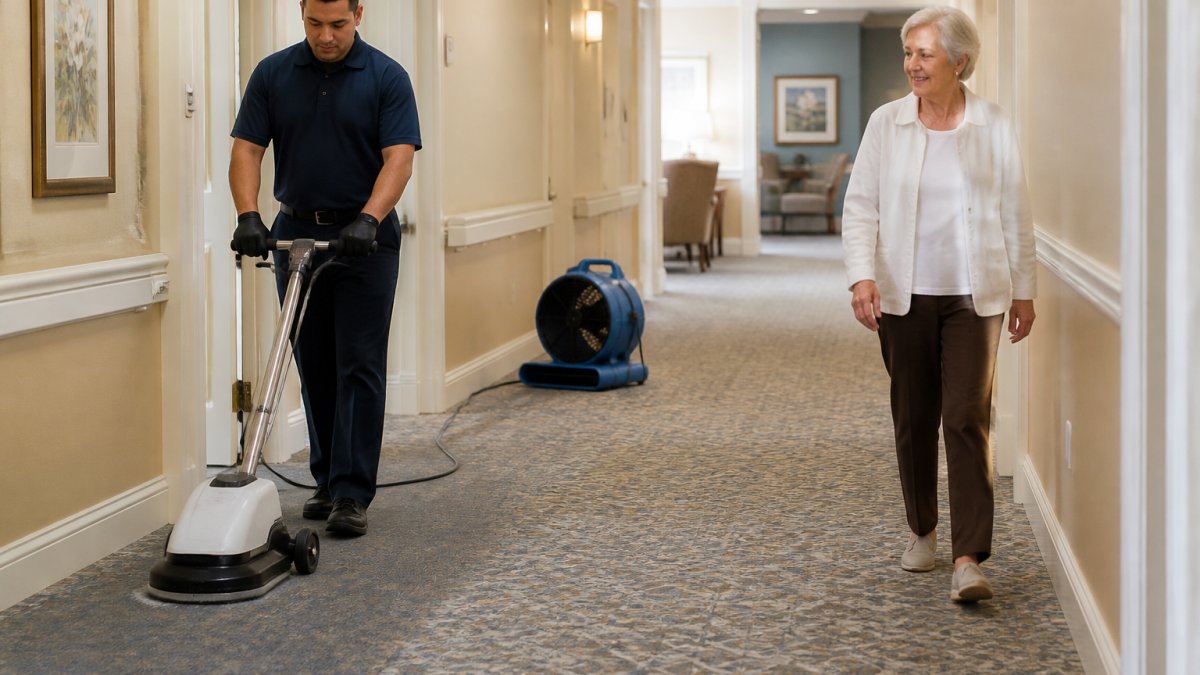
Plan the work around the building’s rhythm, not the crew’s convenience:
- Map the facility into zones, and clean the highest-traffic zone first so it has the longest drying window.
- Schedule noisy extraction during activity periods, when residents are already out of their rooms.
- Keep a physical barrier and clear signage at every wet edge, and brief staff on the route change.
- Run air movers and confirm the HVAC is on cooling or fan mode to keep humidity down.
- Walk the zone with a moisture meter before you release it back to residents.
The Carpet and Rug Institute’s cleaning standards treat proper drying as part of acceptable cleaning practice, not an afterthought. That aligns with what we see on site: most complaints after a commercial job trace back to a zone released too early.
Questions to Ask Carpet Cleaning Companies Before You Sign
The right questions to ask carpet cleaning companies separate a facility contractor from a residential crew with a commercial logo. Ask in writing, and ask for documents rather than verbal assurances.
- Which products will you use, and can you provide safety data sheets and certification numbers before the visit?
- How do you protect residents during cleaning, and who supervises the wet zones?
- What is your background-check and training process for technicians?
The bloodborne pathogen question matters most. The OSHA bloodborne pathogens standard sets requirements for employers whose workers may be exposed to blood or other potentially infectious materials, and a facility contractor handling bodily-fluid contamination should be able to describe their compliance in plain terms.
This is where we draw a clear line. A residential cleaner may be excellent at home carpet and still have no written protocol for occupied care facilities.
Building a Nursing Home Carpet Maintenance Schedule
A nursing home carpet maintenance plan works best as a tiered schedule: daily interim care, monthly low-moisture cleaning, and scheduled deep extraction by zone. Spreading the work keeps any single area out of service briefly and keeps soil from reaching the backing. Sequence it around residents, infection-prevention policy, and inspection cycles so cleaning supports care rather than disrupting it.
| Frequency | Task | Method | Owner |
|---|---|---|---|
| Daily | Spot clean spills and accidents | Enzyme spotter | Housekeeping |
| Weekly | Vacuum traffic lanes and entries | High-filtration vacuum | Housekeeping |
| Monthly | Interim clean high-traffic zones | Low-moisture or VLM | Contractor |
| Quarterly | Deep clean by zone | Hot water extraction | Contractor |
| Annually | Full facility audit and pad inspection | Combined | Director plus contractor |
Coordinate Carpet Care With Infection Prevention
Carpet cleaning is not disinfection, and the schedule should never be written as if it were. The CDC infection prevention guidance for nursing homes treats environmental cleaning as a layered process, and carpet care sits alongside, not in place of, surface disinfection and hand hygiene. Two practical rules follow. First, never let a carpet crew work a room that is under isolation precautions without coordinating with the infection-preventionist; the traffic path, equipment, and waste handling all change.
Plan Around Occupancy, Not Just Frequency
A schedule that ignores the building’s daily rhythm will be abandoned within a month. Build the calendar around these constraints:
- Meal and activity windows. Clean dining and activity rooms while residents are elsewhere, so the highest-traffic zones get the longest drying window.
- Room turnover. Coordinate with nursing staff on discharge, transfer, and admission days so a resident room is cleaned between occupants rather than during a stay.
- Survey and inspection cycles. Land deep cleans before scheduled inspections, not after, so the facility is being judged on its best condition rather than its worst.
Build the Annual Calendar Around Zones
Divide the building into cleaning zones, corridors, dining, activity rooms, resident rooms, and entries, and assign each its own interim and deep-clean dates. A zone-based calendar limits how much carpet is out of service at once, makes vendor pricing comparable, and produces a per-zone record you can hand to an inspector or family member.
Pro Tip
Put the zone map and the annual calendar on one page and post it where housekeeping and nursing staff can both see it. The schedule fails when nursing does not know which wing is wet today.
Put the zone map and the annual calendar on one page and post it where housekeeping and nursing staff can both see it. The schedule fails when nursing does not know which wing is wet today.
How to Measure Whether the Cleaning Actually Worked
Measure cleaning performance with checks that produce a number or a record, not an impression. If carpet looks clean but feels tacky or resoils within days, the job left residue behind, and in a care facility, residue and moisture are also slip and odor risks. A per-zone record showing whether a product or method works in your building beats any certification on a spec sheet.
The Measurable Checks
- Drying time. Record the time from the last extraction pass to the moment a moisture meter reads dry in the deepest part of the pile. Compare across visits and methods; a widening gap usually means airflow, humidity control, or over-wetting has drifted.
- Residue. Rub a white cloth on a dry section of traffic lane. A cloth that comes up largely clean is the pass; a tacky or gray film means surfactant was left behind.
- Odor. Check at the baseboard and near pad edges, not at nose height. Odor that returns within days points to contamination in the pad or subfloor, not the surface.
- Stain removal. Note which stains were fully removed, which lightened, and which returned. A stain that reappears is usually wicking from the backing.
- Re-soiling rate. Note how quickly a zone looks dull again after cleaning and compare across visits. Faster re-soiling is the clearest early signal of residue or under-extraction.
- Complaints. Log resident and staff complaints by zone, odor, dampness, slip concerns, noise. Complaints are data, and a zone that generates them repeatedly needs a method change, not another pass.
Document It Per Zone
Keep a shared log with one row per zone per visit: date, method, product and dilution, drying time, residue result, odor result, stain outcomes, and complaints. Over a few cycles it shows which zones are holding up and which are cleaned on a schedule that does not match their soil load, and it gives you a defensible record if a family member or inspector asks what was done and when.
Compare Total Cost, Not Bottle Price
Product price is the least useful number in the comparison. A concentrate that dilutes at a higher ratio can cost less per cleaned square foot than a cheaper ready-to-use product, and a method that returns a zone to service faster can cost less in labor and resident disruption. When comparing vendors or products, put these on the same page:
- Dilution rate and cost per cleaned square foot, not cost per bottle.
- Labor hours per zone, including setup, dwell time, and drying checks.
- Water and equipment use, especially if the facility pays for water or runs air movers on facility power.
A vendor who will not put these numbers on paper is asking you to compare marketing, not performance. The facilities that get the best value compare total cost per zone over a year, not the price of the jug.
Key Takeaway
The log is the accountability tool. A vendor who welcomes per-zone measurement is usually the one whose method actually holds up.
The log is the accountability tool. A vendor who welcomes per-zone measurement is usually the one whose method actually holds up.
Frequently Asked Questions
How can you tell whether a carpet cleaner is genuinely eco-friendly?
Ask for the specific product name and its safety data sheet, then check the manufacturer’s certification listings rather than the marketing copy. Legitimate eco-friendly carpet cleaners can point to third-party programs such as Green Seal or Safer Choice, list ingredients on request, and explain dilution ratios. A cleaner who answers vaguely or claims ‘all-natural’ without documentation is a warning sign. Also ask whether the product is biodegradable and whether it leaves residue that could affect indoor air quality in resident rooms.
Are eco-friendly carpet cleaning products safe for older adults?
Safety depends on the product, the dilution, and the ventilation during and after cleaning, not on the word ‘green’ alone. Low-toxicity, fragrance-free formulas reduce chemical residues and airborne particles, which matters in a facility where residents may have respiratory conditions. Confirm the cleaner uses measured dilution rather than splash-and-guess, keeps residents out of wet areas until dry, and can supply safety data sheets on request. Ask specifically about fragrance, since added scent is a common irritant.
How often should carpets be professionally cleaned in a nursing home?
High-traffic areas such as dining rooms, corridors, and entryways usually need professional cleaning more often than resident rooms, and spot treatment should happen between scheduled visits. Build the schedule around occupancy and inspection results rather than a fixed calendar. Many facilities clean common areas quarterly and resident rooms on a rotating basis, adjusting for spills, incontinence events, and odor complaints. Document each cleaning so you can show a pattern of maintenance to inspectors and families.
How long does carpet take to dry after professional cleaning?
Drying time depends on the method. Low-moisture and very low moisture cleaning can leave carpet walkable in a couple of hours, while hot water extraction typically needs six to twelve hours depending on humidity, airflow, and carpet density. In an occupied facility, ask the contractor to specify expected drying time in writing and to bring air movers. Schedule cleaning early in the day so the area is dry before evening, and keep residents off wet carpet to prevent falls.


