
- July 29, 2026
- in Blog
- by
- 141
- 0
Last Updated: July 29, 2026
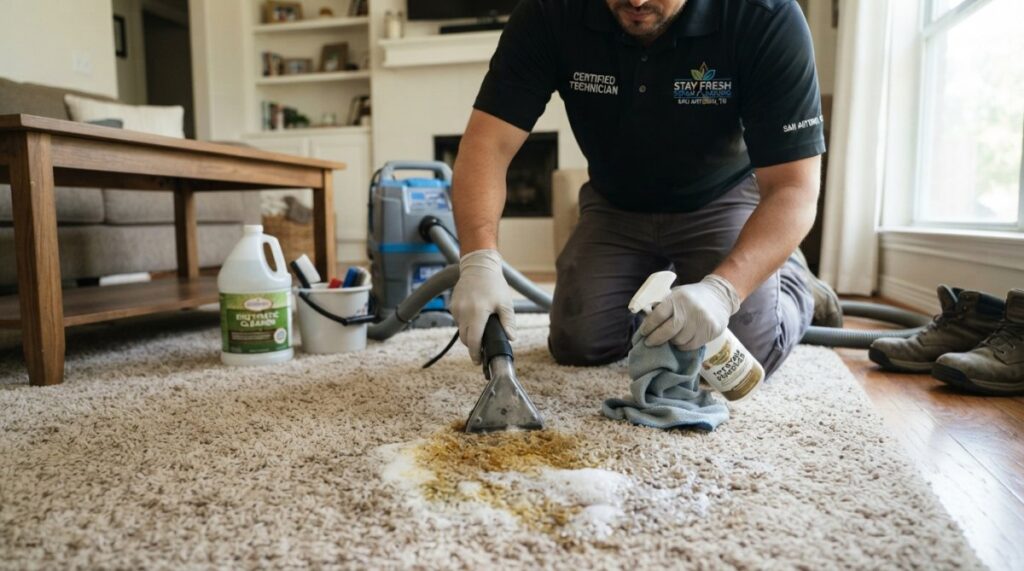
Learning how to remove pet stains from carpet is one of the most practical skills any pet owner can develop. At Stay Fresh Steam Cleaning, we’ve helped hundreds of homeowners tackle everything from fresh accidents to years-old urine damage. The difference between a permanent stain and a fully restored carpet often comes down to knowing the right technique, the right products, and acting fast.
Pet accidents are inevitable. The challenge isn’t just the visible mark, it’s the odor that lingers long after the stain appears dry. That smell comes from uric acid crystals embedded in carpet fibers and soaked into the carpet padding underneath. Most DIY attempts fail because people treat the surface while the padding, where the real problem lives, goes untouched.
Before you tackle a stain, gather your supplies. Having everything on hand means you won’t waste time while the accident sets deeper into the fibers.
Start with white paper towels or clean cloth rags for blotting. Avoid colored towels, as dyes can transfer to light carpets.
Stock white vinegar, hydrogen peroxide, and basic dishwashing detergent, these form the foundation of most effective homemade pet stain removers. A spray bottle lets you apply solutions evenly without oversaturating. A small handheld brush helps agitate stains gently without damaging fibers.
Keep an enzymatic cleaner specifically formulated for pet urine on hand. These break down uric acid at the molecular level, something vinegar and peroxide alone cannot do. You’ll also want baking soda for odor absorption and, if you’re serious about deep cleaning, access to a carpet cleaning machine (rental or professional).
Optional: a blacklight flashlight reveals old urine stains invisible to the naked eye, helping you identify hidden problem areas before they cause odor complaints.
Hydrogen peroxide is generally safe for pets in diluted form, but concentrated solutions can irritate skin and eyes. Always dilute according to instructions.
Vinegar smells strong and can irritate sensitive nasal passages in cats and small dogs. Ensure good ventilation when using vinegar-based solutions. Baking soda is non-toxic but shouldn’t be ingested in large quantities.
Enzyme-based cleaners vary by brand. Check the label for pet-safe certification. Many commercial cleaners contain ammonia or bleach, never mix these with other cleaners, and keep pets away until surfaces are fully dry.
The first 10 minutes after discovering an accident determine whether you’ll have a permanent stain or a complete recovery. Speed and technique matter far more than which cleaning product you use.
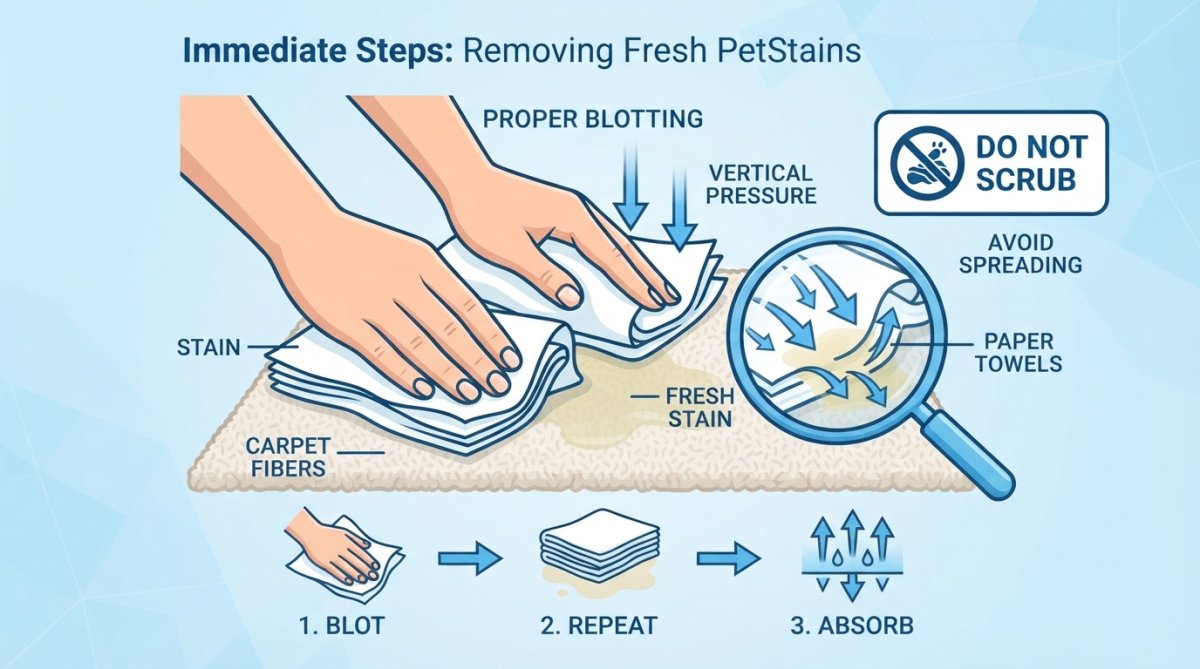
Most people make a critical mistake: they scrub. Scrubbing drives urine deeper into carpet fibers and padding, spreads the stain across a wider area, and breaks down carpet fibers permanently.
Blotting is the opposite. You’re lifting moisture up and out of the carpet, not pushing it down. Place white paper towels or a clean cloth directly on the wet spot. Press down firmly with your body weight for 10-15 seconds. Lift. Replace with fresh towels. Repeat until the towels come away nearly dry.
Blotting removes 60-70% of the liquid before you apply any cleaning solution. Scrubbing removes maybe 20% and embeds the rest.
Once you’ve blotted out as much liquid as possible, you’re ready for cleaning solutions.
Before applying any liquid to your carpet, test it on a hidden area. This takes 60 seconds and prevents catastrophic color loss on visible carpet.
Choose a spot in a closet, under furniture, or in a corner. Apply a small amount of your cleaning solution to a white cloth. Press it against the carpet fibers for 30 seconds. If color transfers to the cloth or the carpet lightens, you’ve found a dye-bleeding risk.
For natural fiber carpets like wool or sisal, this test is especially critical. If your carpet fails the colorfastness test, dilute your solution further or skip it entirely and move straight to an enzyme-based cleaner, which is gentler on dyes.
Professional cleaners charge $150-$400 per room. Homemade solutions cost a fraction of that and work remarkably well for fresh stains.
White vinegar neutralizes urine odor by breaking down the ammonia compounds responsible for the smell. Mix one part white vinegar with one part warm water in a spray bottle. After blotting, spray the stained area generously until the carpet is damp but not soaked. Let it sit for 5-10 minutes. Blot again with fresh towels.
Once the vinegar has dried (usually 2-3 hours), sprinkle baking soda directly over the area. Leave it for 12-24 hours, then vacuum thoroughly. This combination works best on fresh urine stains (less than 24 hours old).
This combination is more aggressive than vinegar and works better on older, dried stains. Hydrogen peroxide oxidizes uric acid crystals, breaking them down. Dishwashing detergent helps lift and suspend the broken-down particles so they can be rinsed away.
Mix 1 cup of 3% hydrogen peroxide, 3 tablespoons of baking soda, and 2-3 drops of dishwashing detergent (non-bleach formula). Stir until the baking soda dissolves. Pour into a spray bottle.
After blotting the stain, spray the solution generously over the affected area. Let it sit for 5-10 minutes. Blot thoroughly with clean towels. Rinse the area with cool water and blot again to remove any residue. Test this solution on a hidden area first, as hydrogen peroxide can lighten some carpet dyes.
Homemade solutions handle fresh stains well. For older stains, set-in odors, and urine soaked into carpet padding, enzyme-based cleaners are the only solution that truly works.
Pet urine contains uric acid, a compound that doesn’t break down with water, vinegar, or hydrogen peroxide alone. Uric acid crystals remain in carpet fibers and padding indefinitely, continuing to release odor.
Enzyme-based cleaners contain protease and urease enzymes that literally break down uric acid molecules into harmless compounds that can be rinsed away. This is why enzyme cleaners work on old stains that vinegar won’t touch.
When choosing an enzyme cleaner, look for products specifically labeled for pet urine. Apply according to product instructions; most require saturating the stain and leaving it for 24-48 hours while the enzymes work. The smell may temporarily worsen as enzymes work and uric acid breaks down. This is normal and indicates the product is working.
Fresh stains are one problem. Old stains that have been there for months or years require a different approach because the urine has migrated deep into carpet padding and potentially into the subfloor.
The carpet backing and padding underneath hold far more urine than the visible fibers. When urine soaks through carpet fibers, it pools in the padding where surface treatments can’t reach it.
If you’ve applied vinegar, peroxide, or enzyme cleaners to an old stain and the smell keeps returning, the padding is saturated. Surface treatments won’t fix this.
The only permanent solution is professional deep cleaning with extraction (which pulls moisture and dissolved urine from the padding) or, in severe cases, replacing the padding and potentially the carpet itself.
If you’re committed to DIY rescue, saturate the stain with enzyme cleaner and allow it to soak deep into the padding. Cover the area with plastic sheeting to slow evaporation and leave it for 48-72 hours. After enzyme treatment, you’ll need to extract moisture using a rental carpet cleaning machine. You may need to run the extraction process multiple times to fully remove moisture and dissolved urine from the padding.
Dried stains that haven’t been treated with enzymes yet are easier to address than those that have been through failed cleaning attempts.
Start by vacuuming the area thoroughly. Then apply an enzyme-based cleaner according to product instructions. For stubborn, old stains, consider using a heated carpet cleaning machine; heat activates enzymes and helps them penetrate deeper into fibers.
After enzyme treatment and extraction, the carpet may feel damp. Residual moisture can lead to mold growth and musty odors. Use fans, open windows, or a dehumidifier to speed drying. The entire process typically takes 48-72 hours for a stubborn old stain.
Odor and stains are related but not identical. You can remove a visible stain and still have odor. Understanding this distinction changes how you approach the problem.
Odor neutralizers work differently than stain removers. While enzyme cleaners break down uric acid, odor neutralizers chemically bind to odor-causing molecules, rendering them odorless.
Many commercial odor neutralizers use activated charcoal, baking soda, or proprietary chemical compounds. These work best on surfaces that are already clean; applying an odor neutralizer to a carpet that still contains uric acid is ineffective.
pH-balanced solutions are important for carpet longevity. Urine is acidic, and many cleaning solutions are alkaline. Leaving alkaline residue in carpet can cause yellowing and attract dirt. After any treatment, rinse the area with pH-neutral water or a pH-balanced rinse solution to remove residue.
This step separates professional results from mediocre DIY attempts. After treating a stain with vinegar, peroxide, or enzyme cleaner, you must extract the moisture and dissolved urine.
Blotting by hand removes surface moisture. A carpet cleaning machine extracts moisture from deep within carpet fibers and padding. Rental machines cost $30-$50 per day and are significantly better than blotting alone.
Run the extraction process multiple times over the same area. Each pass removes more moisture and more dissolved urine. Stop when the carpet feels barely damp rather than wet. Once the carpet is dry, vacuum thoroughly. If odor persists after extraction and vacuuming, the padding is likely still saturated, and professional cleaning or padding replacement becomes necessary.
Rental carpet cleaning machines are tempting because they’re affordable and available. Understanding their limitations helps you decide whether DIY is worth attempting.
Rental machines hold about 15-20 gallons of water and spray hot water onto carpet while simultaneously extracting it back out. In practice, rental machines leave carpet wetter than professional equipment. Professional machines extract with much greater force, removing 40-50% more moisture.
This matters because wet carpet dries slowly, creating an environment where mold and mildew can develop. Professional equipment also lacks the precision of professional technicians, who adjust water temperature, pressure, and extraction strength based on carpet type and fiber.
For fresh stains, a rental machine combined with enzyme cleaner can work adequately. For old stains involving carpet padding saturation, rental machines often fail to extract enough moisture, leaving the problem partially solved. Professional cleaning also addresses the entire carpet, not just the stain.
Using ammonia-based cleaners. Ammonia smells like urine to pets and teaches them the spot is a good place to mark territory.
Scrubbing instead of blotting. Scrubbing drives urine deeper into carpet and breaks down fibers, making stains worse.
Skipping the colorfastness test. One minute of testing prevents permanent color loss.
Using too much water. Oversaturating carpet doesn’t clean better and increases mold risk.
Treating only the surface. If you have a multi-year-old stain with persistent odor, the padding is saturated and needs extraction or professional cleaning.
Waiting too long to treat fresh stains. Every hour you delay, urine soaks deeper. Treat accidents immediately.
Not extracting enough moisture. Blotting by hand is not enough. You need a machine to properly extract moisture from carpet padding.
Assuming the problem is solved when the stain disappears. Visible stains and odors are separate issues. Odor means uric acid remains in the carpet or padding.
Removing pet stains from carpet is achievable with the right approach and products, but persistent odors and deep stains often require professional intervention. If you’ve tried enzyme cleaners, extraction, and multiple treatments and the smell still returns, the carpet padding is likely beyond DIY repair. Stay Fresh Steam Cleaning uses truck-mounted extraction equipment and professional-grade enzyme treatments that reach deep into padding and subfloor. We guarantee complete odor elimination or we re-clean at no charge. Contact Stay Fresh Steam Cleaning today for a consultation; we serve San Antonio and Bexar County with certified, background-checked technicians and a satisfaction guarantee.
A mixture of white vinegar, baking soda, and warm water is effective for fresh stains, while hydrogen peroxide combined with dishwashing detergent works well for tougher stains. For the best results, blot the area first with paper towels, apply your chosen solution, let it sit for 10-15 minutes, then blot again. However, enzyme-based cleaners specifically designed to break down uric acid in pet urine often outperform homemade solutions for lingering odors.
Old pet stains require deeper penetration than fresh ones. Saturate the stained area with an enzyme-based cleaner or pH-balanced solution, allowing it to soak for several hours or overnight to reach the carpet fibers and padding. Use a spray bottle to apply the solution evenly, then extract with a carpet cleaning machine or damp cloth. If the carpet padding beneath is saturated, you may need professional extraction equipment or professional treatment to prevent sub-floor damage and persistent odors.
Yes, enzyme-based cleaners are highly effective because they contain biological enzymes that break down uric acid and other compounds in pet urine that cause both stains and odors. Unlike ammonia-based cleaners that can actually attract pets back to the same spot, enzymes neutralize the source of the problem. For best results, choose non-bleach, non-lanolin enzyme cleaners, apply them generously to saturate the affected area, and allow adequate dwell time before extraction.
Fresh, small stains can often be handled with DIY solutions using white vinegar, hydrogen peroxide, or enzyme-based cleaners. However, multiple accidents, old stains, or saturation of carpet padding typically require professional treatment. Professional services use industrial-grade extraction equipment and advanced techniques that reach deeper into carpet fibers and backing. If odors persist after your DIY attempts or you're concerned about potential sub-floor damage, professional cleaning is worth the investment to preserve your carpet's longevity.
This article was written using GrandRanker


