
- 12
- 0
Table of Contents
- Start With the Carpet, Not the Vacuum
- Upright vs. Canister: Which Carpet Vacuum Fits Your Space
- Vacuum Settings for Different Carpet Types
- Choosing a Vacuum for High-Pile Carpet
- Choosing a Vacuum for High-Traffic Carpet
- Carpet Vacuum Maintenance That Protects Your Floors
- How to Test a Carpet Vacuum Before You Buy
- Conclusion: Match the Machine to Your Carpet
- Frequently Asked Questions
Last Updated: October 14, 2026
Start With the Carpet, Not the Vacuum
Most people buy a carpet vacuum by picking the loudest “powerful suction” claim, then wonder why the brush roll snags and the pile looks crushed a week later.
At Stay Fresh Steam Cleaning, a family-owned carpet and upholstery cleaning company serving San Antonio and Bexar County, we see it every week.
A carpet vacuum is built for a specific job defined by your carpet. Before comparing models, know two things: fiber and pile height.
Identify Your Carpet Fiber and Pile Height
Pile height is the distance from the carpet backing to the top of the fibers. It comes in three basic ranges:
- Low pile (under 1/4 inch): Berber, loop, and commercial-grade carpet
- Medium pile (1/4 to 1/2 inch): Most residential cut-pile and textured carpet
- High pile (over 1/2 inch): Frieze, shag, and some luxury plush styles
Fiber matters too: nylon and polyester tolerate aggressive brushing, while wool and other natural fibers can fray or fuzz under a stiff brush roll.
Run your hand across the carpet: fingers disappearing means high pile, feeling the backing means low pile.
Match Your Household to the Right Machine
- Pet owners: Need strong debris pickup, sealed filtration, and a brush roll that resists hair wrap
- Allergy sufferers: Need HEPA filtration and a sealed system so fine particles stay inside the machine
- Multi-level homes: Need a machine light enough to carry up stairs
Most homes with multiple carpet types do better with one primary vacuum plus a smaller unit for stairs and tight spaces.
Upright vs. Canister: Which Carpet Vacuum Fits Your Space
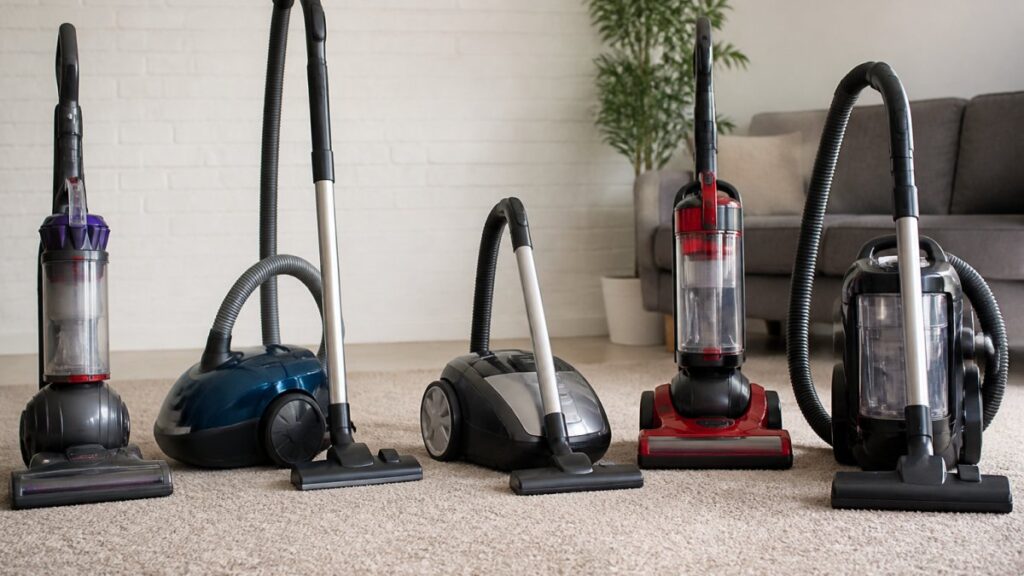
Upright vacuums win on deep carpet: their weight presses bristles into the pile for stronger agitation that pulls embedded dirt out of medium and low-pile carpet.
Canister vacuums win on reach: the body stays on the floor while the wand and powerhead go under beds, along baseboards, and up stairs, and many swap to a bare-floor tool in seconds.
| Factor | Upright Vacuum | Canister Vacuum |
|---|---|---|
| Best for | Wall-to-wall medium and low pile | Stairs, tight spaces, mixed flooring |
| Carpet agitation | Strong, weight-assisted | Good with a powered head |
| Maneuverability | Limited around furniture | High, wand reaches under furniture |
| Weight | Heavier to carry | Lighter to lift, body drags behind |
| Storage | Compact, stands upright | Bulkier, hose needs coiling |
Quick rule: mostly carpet, buy an upright; mostly hard floor with a few carpeted rooms, buy a canister with a powered brush head.
Pro Tip
Check whether the canister’s powerhead has its own motor. A suction-only head will not agitate carpet fibers, and you’ll leave half the embedded dirt behind no matter how strong the suction is.
Check whether the canister’s powerhead has its own motor. A suction-only head will not agitate carpet fibers, and you’ll leave half the embedded dirt behind no matter how strong the suction is.
The Fiber Question Changes the Answer
Fiber is the tiebreaker and can override the upright-versus-canister rule entirely.
- Nylon and polyester: Tough, resilient, and tolerant of aggressive brushing. An upright with a stiff brush roll is usually safe here, even on medium pile.
- Olefin (polypropylene): Resists stains and moisture but crushes and mats under heat and friction. A canister with a gentler brush roll, or an upright run at a higher height setting, reduces the burnishing that flattens olefin loops.
- Wool: Soft, springy, and prone to fuzzing when a stiff brush beats against it. Many wool manufacturers recommend suction-only cleaning or a very soft brush roll. A canister with a powered head you can switch off is often the safer pairing.
A common pattern: a household buys an upright for wall-to-wall nylon, then adds a wool area rug and finds the same machine fuzzes it, the case for one aggressive and one gentle machine.
The Ownership Costs Nobody Puts in the Table
The sticker price is the smallest number in the decision. Lifetime cost has four buckets:
- Purchase price: Uprights and canisters overlap widely here, so price alone rarely settles the choice.
- Consumables: Bags, belts, and filters. Bagged machines cost more per year in bags but often hold more debris and release less dust on emptying. Bagless machines save on bags but add filter cleaning and replacement.
- Filters: HEPA filters are the recurring cost most buyers forget. Washable filters cut the cost but need full drying time before reuse.
To compare two machines, estimate annual consumable cost (bags plus filters plus belts), multiply by expected years of ownership, and add the purchase price. The cheaper machine up front isn’t always cheaper over five years.
Weigh the Everyday Trade-Offs
These factors rarely appear in spec sheets but decide whether you actually use the vacuum:
- Weight: An upright’s weight is an asset on carpet and a liability on stairs. If your carpeted rooms are upstairs, lift the machine before you buy.
- Noise: Quieter machines get used more often. Test at full power in the store rather than trusting a decibel rating.
- Storage: Uprights stand upright in a closet; canisters need floor space plus room to coil the hose.
A Short Decision Path
- Identify your dominant carpet fiber and pile height.
- Wool, viscose, or other delicate natural fiber: lean canister with a switchable powered head, or plan for suction-only cleaning.
- Nylon or polyester wall-to-wall: lean upright for the agitation advantage.
- Mostly hard floor with a few carpeted rooms: lean canister.
- Check weight, noise, storage, and consumable costs before you commit.
Vacuum Settings for Different Carpet Types
Vacuum settings for different carpet types come down to three controls: height, suction, and brush roll.
Height raises or lowers the nozzle so the brush roll touches the pile without digging into the backing; suction control dials back airflow on delicate or high-pile carpet; the brush roll switch turns agitation on or off.
Adjust Height, Suction, and Brush Roll Together
Treat these three settings as a single dial.
- Low pile: Lowest height, full suction, brush roll on
- Medium pile: Middle height, full suction, brush roll on
- High pile: Highest height, reduced suction, brush roll off or on low
If the vacuum is hard to push, the height is too low; if debris stays on the surface, it’s too high. Adjust in small steps until the machine glides without straining.
Airflow lifts dirt. Pressing the nozzle too deep into thick pile chokes airflow and kills cleaning power even though the motor sounds fine.
Choosing a Vacuum for High-Pile Carpet
A vacuum for high-pile carpet needs one feature above all: a brush roll you can turn off.
Look for these traits in a high-pile machine:
- Adjustable nozzle height that reaches the tallest setting
- A brush-roll on/off switch
- Suction control to reduce airflow at the nozzle
Shag and frieze are hardest: many manufacturers recommend suction-only cleaning with a bare-floor attachment or dedicated high-pile head. Check your carpet’s warranty before running any brush roll across it.
High-pile carpet hides dirt better than it releases it. Regular, gentle passes beat occasional aggressive ones.
Choosing a Vacuum for High-Traffic Carpet
A vacuum for high-traffic carpet needs the opposite: maximum agitation and full suction to pull embedded dirt out of compressed fibers.
High-traffic zones, entryways, hallways, stairs, and the kitchen-to-living-room path, collect grit that grinds against fibers like sandpaper and wears carpet down from the inside.
For these areas:
- Use the lowest height setting that still lets the machine glide
- Keep suction at full power
- Run the brush roll at full speed
Slow passes matter: the brush roll needs contact time to loosen embedded dirt, and racing at walking speed leaves most of it behind.
Key Takeaway
The single biggest upgrade to carpet cleaning power is not a stronger motor. It’s slowing down and overlapping your passes by about half the cleaning width.
The single biggest upgrade to carpet cleaning power is not a stronger motor. It’s slowing down and overlapping your passes by about half the cleaning width.
Measure Whether the Vacuum Is Actually Working
Few guides tell you how to confirm the machine is actually working. These checks turn “it seems to work” into evidence:
- Bin or bag yield: After ten slow, overlapping passes over a visibly soiled lane, a working vacuum pulls a noticeable amount of grit and gray dust. If the bin is nearly empty, your height or brush roll is mismatched to the pile.
- Pile recovery: Look at the carpet at a low angle in raking light. Freshly vacuumed pile should stand up and show brush marks. If it stays flattened, the brush roll is not reaching the fibers.
- Push effort: The machine should glide with light effort at the working height. If you are straining, the nozzle is too low and you are choking airflow.
Troubleshoot a Vacuum That Fights Back or Flattens Pile
Two complaints dominate high-traffic carpet: the vacuum is hard to push, or the carpet looks crushed afterward. Both usually trace to settings, not a broken machine.
Hard to push:
- Raise the nozzle one height notch and test again.
- Reduce suction if the machine has a control, especially on plush or frieze.
- Check the brush roll for wrapped hair, string, or carpet fibers, a loaded brush roll drags.
- Confirm the belt is intact and the brush roll spins freely by hand.
- Check the bag or bin; a full bag reduces airflow and can make the head seal to the carpet.
Carpet looks flattened or matted:
- Raise the height so the brush roll grazes the pile surface instead of digging into the backing.
- Cut suction back on high-pile or delicate fibers.
- Switch the brush roll off on wool, viscose, or shag.
- Change direction each time you vacuum so pile is not pushed the same way every pass.
- If flattening persists, the brush roll is too stiff for the fiber, switch to a gentler head or suction-only cleaning.
Build a High-Traffic Routine That Holds Up
- Vacuum high-traffic lanes twice as often as the rest of the room.
- Use a walk-off mat at every entry so grit is captured before it reaches the carpet.
- Rotate pass direction week to week to reduce directional matting.
In high-traffic homes, the vacuum is often fine and the routine is the problem. Slower passes, more overlap, and more frequent cleaning of the busiest lanes do more for carpet life than any feature on the box.
Carpet Vacuum Maintenance That Protects Your Floors
Carpet vacuum maintenance is the difference between a machine that lasts years and one that quits in eighteen months.
Build this routine into your schedule:
- Every use: Empty the bin or replace the bag when it’s two-thirds full
- Monthly: Cut hair and string off the brush roll with scissors
- Monthly: Wash or replace foam and HEPA filters per the manual
A worn belt is the most overlooked problem: when it stretches, the brush roll slows and agitation drops even though the motor sounds normal.
Pet hair wraps around brush rolls and chokes airflow faster than any other debris. With dogs or cats, check the brush roll weekly, not monthly.
Watch Out
Never wash a HEPA filter and put it back damp. Trapped moisture grows mold inside the housing, and every pass afterward spreads spores across your carpet. Let filters dry fully for at least 24 hours.
Never wash a HEPA filter and put it back damp. Trapped moisture grows mold inside the housing, and every pass afterward spreads spores across your carpet. Let filters dry fully for at least 24 hours.
How to Test a Carpet Vacuum Before You Buy
Testing a carpet vacuum before you buy takes about five minutes. Ask for a carpet sample matching your pile height, then run these checks.
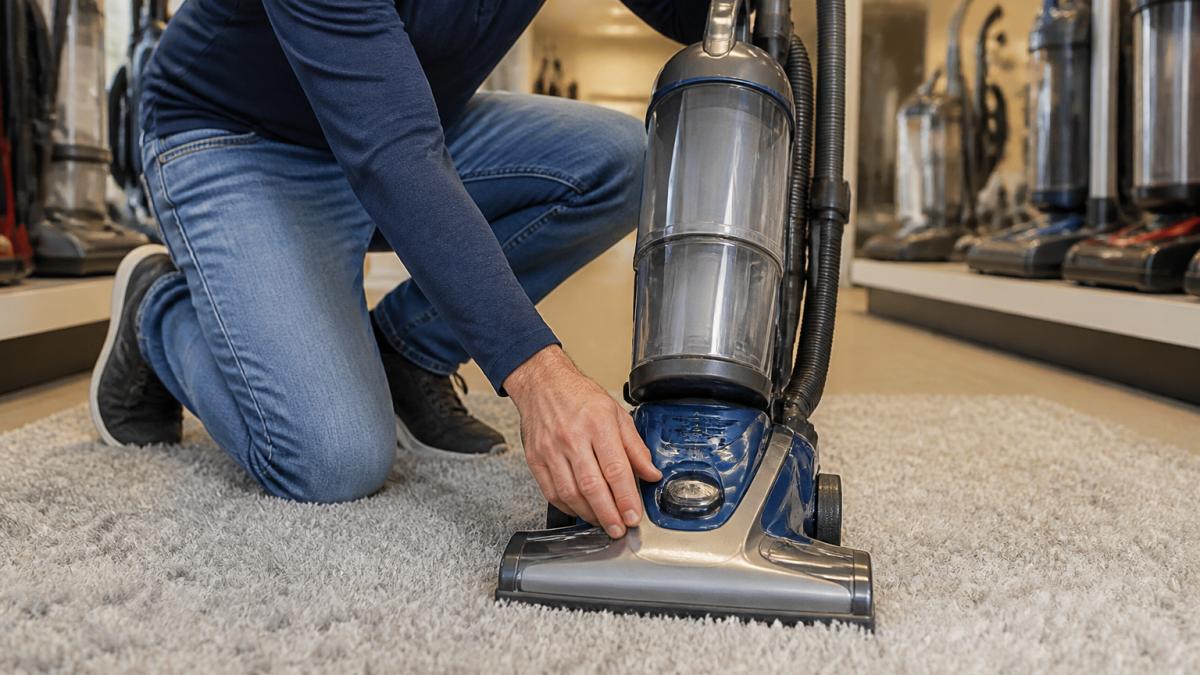
- Push test: Set the height to its middle setting and push forward. It should glide with light effort. If you’re straining, the height range won’t cover thick carpet.
- Brush-roll check: Flip the machine over and look at the bristles. They should extend past the base plate by roughly a quarter inch. Short, stiff bristles suit low pile. Longer, softer bristles suit high pile.
- Suction test: Place your palm flat over the hose end. You should feel strong pull within a second or two.
- Weight test: Lift the machine with one hand. If you can’t hold it for ten seconds, carrying it up stairs will be a chore.
- Noise check: Run it at full power. Above roughly 80 decibels, you’ll avoid using it as often as you should.
- Turn test: Push it in a tight circle. If the head resists turning, maneuvering around furniture will frustrate you.
At home, test on your actual carpet before the return window closes. Run ten slow passes over a visible traffic lane and check the bin.
If a vacuum is hard to push or leaves carpet flattened, the fix is usually a height setting, not a new machine.
Pro Tip
Bring a small square of your own carpet to the store if you can. Retail display samples are almost always low-pile commercial loop, which tells you nothing about how a machine handles your plush bedroom carpet.
Bring a small square of your own carpet to the store if you can. Retail display samples are almost always low-pile commercial loop, which tells you nothing about how a machine handles your plush bedroom carpet.
Conclusion: Match the Machine to Your Carpet
Even the best carpet vacuum only removes surface debris. It can’t pull embedded grit, oils, and pet accidents out of the backing, and those shorten carpet life.
That’s where professional extraction comes in. Stay Fresh Steam Cleaning sends certified, background-checked technicians across San Antonio and Bexar County, using advanced methods to revitalize carpets, upholstery, tile, and hardwood.
Get started with Stay Fresh Steam Cleaning and protect the carpets you just learned how to care for.
Frequently Asked Questions
Should you use a beater bar on every type of carpet?
No. Beater bars and rotating brush rolls work well on low- and medium-pile carpet because they agitate embedded dirt loose. On shag or delicate wool, that same agitation can fray fibers and fuzz the pile. For those carpets, switch the brush roll off or choose a suction-only head with adjustable height. Always check the carpet manufacturer’s warranty first, since some void coverage if a beater bar is used.
What vacuum settings should you use for different carpet types?
For low-pile and Berber, set the nozzle low and use medium-to-high suction with the brush roll on. For medium pile, raise the nozzle one step and keep suction steady. For high-pile or shag, raise the nozzle to its highest setting, reduce suction, and turn the brush roll off if the vacuum allows it. The goal is to let air move through the pile without dragging the head or pulling fibers.
What is the difference between a carpet vacuum and a carpet cleaner?
A carpet vacuum removes dry debris, dust, and pet hair from the surface and top of the pile. A carpet cleaner injects water or solution and extracts it to lift stains and deep-set soil. You need both: routine vacuuming keeps soil from grinding into fibers, and periodic deep cleaning removes what a vacuum cannot reach. Skipping vacuuming shortens the life of any carpet, no matter how often it is cleaned.
How often should you vacuum carpet in a busy household?
High-traffic areas and homes with pets benefit from vacuuming two to three times a week, while low-traffic bedrooms can be done weekly. The key is to slow down and make multiple passes, since speed is the main reason soil stays behind. Pair that routine with professional deep cleaning every 12 to 18 months, or sooner if you have pets, kids, or allergy concerns.


