
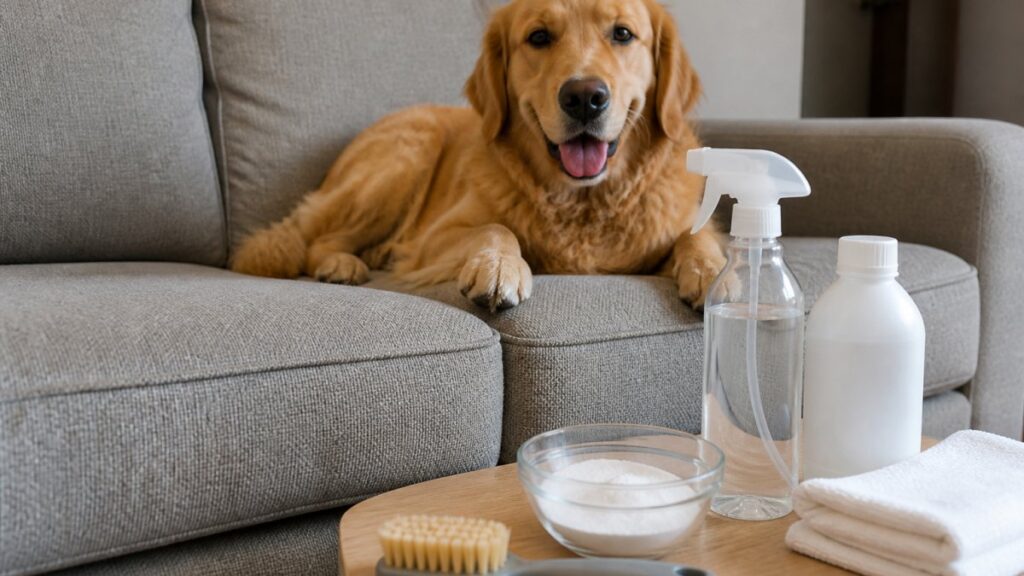
- 14
- 0
Table of Contents
- Step 1: Check the Fabric Care Code and Spot Test First
- Step 2: Strip Pet Hair, Dander, and Loose Debris
- Step 3: How to Remove Pet Urine Odor from Upholstery
- Step 4: Does Baking Soda Remove Pet Odor from a Couch?
- Step 5: Enzyme Cleaner for Upholstery: How to Use It Right
- Step 6: The Best Odor Eliminator for Couches (and What to Avoid)
- Step 7: Dry the Couch Completely to Stop Odor from Coming Back
- Common Mistakes That Make Pet Odors Worse
- Frequently Asked Questions
Last Updated: October 13, 2026
Step 1: Check the Fabric Care Code and Spot Test First
Before touching any cleaning product, find the fabric care code on your couch. This prevents the most expensive mistake in upholstery cleaning: setting a stain or bleaching the fabric permanently.
The care code is a short letter on a tag under the cushions or on the frame.
Reading the W, S, WS, or X Code on Your Couch
Each letter means something specific:
- W – Water-based cleaners are safe. Most common code.
- S – Solvent-based cleaners only. Never use water.
- WS – Either water or solvent cleaners work.
Check the FTC care labeling guidance for upholstered furniture if your tag is missing or faded. No code means you treat the fabric as delicate and test everything first.
How to Run a Spot Test on an Inconspicuous Area
A spot test takes two minutes and saves you a couch.
- Pick a hidden spot, like the back of the frame or under a cushion.
- Apply a small amount of your cleaning solution with a white cloth.
- Wait 10 minutes and check for color loss, bleeding, or shrinking.
- Let it dry fully before you judge the result.
If the fabric changes at all, stop. Try a different method or call a pro.
Watch Out
Never skip the spot test, even on a fabric you think you know. Two couches with the same label can react differently based on dye lots and wear. A failed test on a hidden area costs nothing. A failed test on the seat cushion costs a new couch.
Never skip the spot test, even on a fabric you think you know. Two couches with the same label can react differently based on dye lots and wear. A failed test on a hidden area costs nothing. A failed test on the seat cushion costs a new couch.
Step 2: Strip Pet Hair, Dander, and Loose Debris
Pet hair and dander block cleaners from reaching the fabric, so every product sits on top of the mess instead of breaking down pet odors.
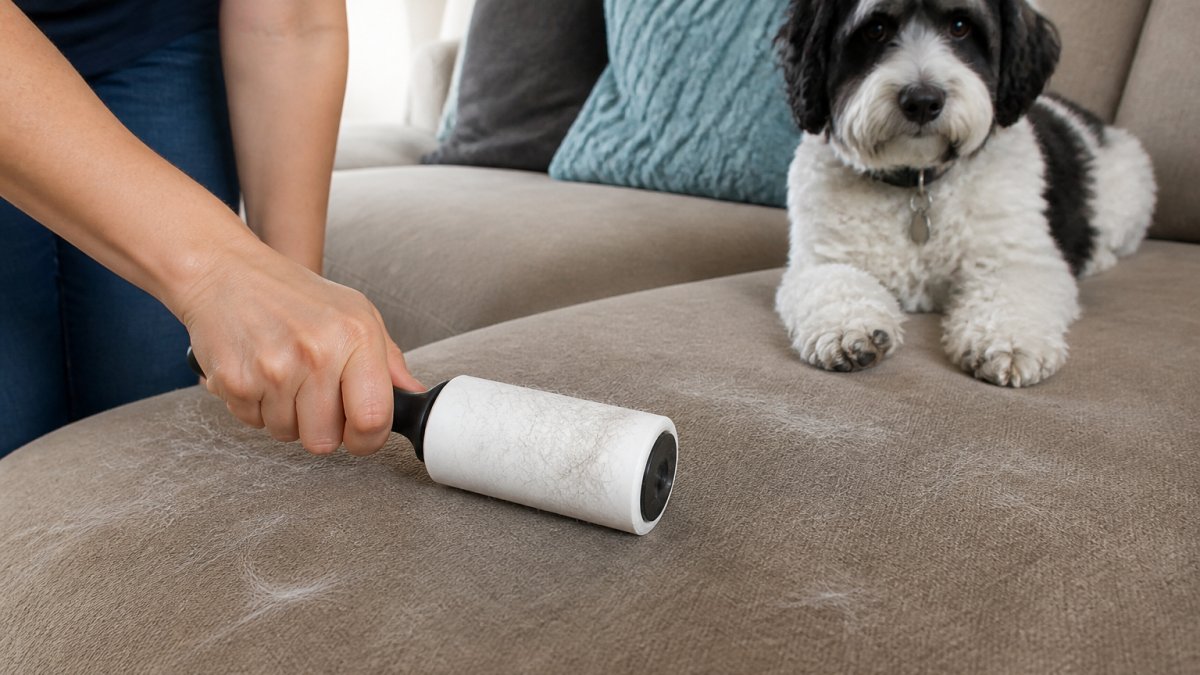
Start with a vacuum and brush attachment, working in slow, overlapping passes across cushions, seams, and under-cushion areas where hair and dander collect in thick bands.
For stubborn hair, a lint roller or damp rubber glove pulls fibers off fast, and a soft brush lifts dander from the weave.
- Vacuum cushions, seams, and under-cushion areas
- Use a lint roller for embedded hair
- Brush the fabric to lift dander
Step 3: How to Remove Pet Urine Odor from Upholstery
The best way to remove pet urine odor from upholstery is to match the treatment to how deep the urine traveled. Urine is roughly 95% water; the remaining urea, uric acid, and salts are what keep smelling.
Confirm your fabric care code first. A W or WS code tolerates the water-based rinsing steps below. An S code means water can ring or shrink the weave, so use a solvent-based cleaner and an enzyme product labeled safe for S-coded fabric.
Tier 1: Fresh Accident (Still Wet, Under 24 Hours)
Speed matters more than product, pull liquid out before it wicks into the foam.
- Press a clean, dry white towel onto the spot and stand on it if the cushion can take the weight, body weight drives moisture up into the towel.
- Swap towels as they soak through until no moisture transfers to a fresh towel.
- Mix 1 teaspoon of mild dish soap with 1 cup of cool water in a spray bottle. Spray lightly, do not flood the fabric.
- Blot again, rinse with a cloth dampened with plain water, and blot dry.
- Apply an enzymatic cleaner while the area is still slightly damp, enzymes work best in a moist environment.
Never use heat or steam on fresh urine. Heat sets the proteins and can bake the odor into the fabric permanently.
Tier 2: Set-In Stain (Dry, Days to Weeks Old)
Old urine has dried and the uric acid has bonded to the fibers. You may see no stain, but the smell returns when humidity rises. Soap cleans surface soil, not uric acid crystals, so you need an enzymatic cleaner, and time.
- Use a blacklight to locate the actual deposit, urine glows under UV light, so you treat the source instead of guessing.
- Re-wet the area with cool water so the dried residue can re-dissolve; enzymes need moisture to function.
- Apply the enzymatic cleaner generously enough to reach the padding, not just the surface.
- Cover with a damp towel to slow evaporation and let the enzymes work. Follow the label’s dwell time, most need 10 to 15 minutes, heavy odors longer.
- Blot up excess and let the fabric air-dry with airflow. If odor returns, repeat the enzyme step once.
Tier 3: Deeply Soaked (Odor Returns After Two or More Treatments)
If the smell returns after two full enzyme cycles, urine has reached the cushion foam or frame. Three options:
- Extract the foam. If the cushion cover unzips, remove it, wash it per its care label, and treat the foam core separately with an enzyme soak followed by thorough drying.
- Replace the foam. Cushion foam is often the cheapest part of the couch to replace, and it is the only reliable fix when urine has saturated the core.
- Call a professional. Truck-mounted hot-water extraction with an enzyme pre-treatment reaches deeper than any consumer spray, but it cannot rescue foam that has been repeatedly soaked.
Pro Tip
A blacklight is the single fastest way to find hidden urine deposits before they spread. Walk the couch slowly in a dark room and mark every glowing spot with a piece of painter’s tape so you can treat them all in one pass.
A blacklight is the single fastest way to find hidden urine deposits before they spread. Walk the couch slowly in a dark room and mark every glowing spot with a piece of painter’s tape so you can treat them all in one pass.
What Not to Do
- Do not rub. Rubbing pushes urine deeper and spreads the residue sideways through the weave.
- Do not use ammonia-based cleaners. Urine contains ammonia, so an ammonia cleaner signals ‘mark here again’ to your pet.
- Do not use bleach. It damages most upholstery fibers and is toxic to pets.
Keep pets and children off the treated area until it is fully dry, wet fabric plus a curious pet is a recipe for a second accident in the same spot.
Step 4: Does Baking Soda Remove Pet Odor from a Couch?
Baking soda removes surface pet odor from a couch, but it does not eliminate the source. Its porous particles trap some volatile odor molecules and neutralize a portion of acidic compounds on contact, a real but surface-level effect. It cannot reach uric acid crystals soaked into the cushion foam, and it cannot break down the proteins and bacteria that keep generating new odor.
When Baking Soda Actually Helps
- Light, surface-level pet smell, the ‘dog was on the couch’ smell that lingers after the pet leaves, with no accident involved.
- Between deep cleans, as a maintenance pass to keep mild odor from building up.
- After an enzyme treatment has dried, to absorb residual surface odor while the deeper treatment finishes working.
When Baking Soda Is the Wrong Tool
- Urine, vomit, or diarrhea, these need an enzymatic cleaner. Baking soda leaves the source untouched, so the smell returns within days.
- S-coded fabric, baking soda is dry, so it is generally safe on S-coded upholstery, but do not follow it with a water-based rinse. Vacuum it up thoroughly so no residue attracts soil.
- X-coded fabric, vacuum-only fabrics can take a dry baking soda pass, but skip any liquid step that follows.
How to Use Baking Soda Correctly
- Vacuum first with a brush attachment, baking soda on hair and dander does nothing.
- Sprinkle a generous, even layer over dry fabric for visible coverage, not a dusting.
- Let it sit at least 15 minutes; for mild odor, 30 minutes to an hour. Longer risks residue settling into the weave.
- Vacuum it up completely with a brush attachment, twice, leftover powder attracts soil and can leave a white haze on dark fabric.
- If odor remains, do not add more baking soda. Move to an enzymatic cleaner; the source is below the surface.
A Stronger Baking Soda Pairing
For mild odor on W or WS fabric, a baking soda paste lifts surface residue better than dry powder. Mix 3 parts baking soda with 1 part cool water, apply a thin layer, let it sit 15 minutes, then blot and rinse with a damp cloth. Test on a hidden area first, the paste can ring dark or loosely woven fabrics.
Key Takeaway
Baking soda is an odor absorber, not an odor eliminator. It buys you time between deep cleans and handles mild surface smell well. For urine, vomit, or any odor that returns after drying, the fix is an enzymatic cleaner applied to the source, not more baking soda.
Baking soda is an odor absorber, not an odor eliminator. It buys you time between deep cleans and handles mild surface smell well. For urine, vomit, or any odor that returns after drying, the fix is an enzymatic cleaner applied to the source, not more baking soda.
What Baking Soda Will Not Do
- It will not kill bacteria or mold that cause odor.
- It will not neutralize uric acid crystals in foam.
- It will not replace vacuuming, which removes the hair and dander that hold odor in the first place.
If you have used baking soda correctly and the smell is still there after 24 hours, the problem is below the surface. Move to the enzyme step and, if that fails twice, consider professional extraction or foam replacement.
Step 5: Enzyme Cleaner for Upholstery: How to Use It Right
Enzyme cleaner for upholstery is the most effective tool against pet urine and organic messes. The enzymes digest the proteins and uric acid that cause persistent odor, removing the smell at the source.
Apply it like this:
- Spot test first, always.
- Spray or pour enough cleaner to reach the padding, not just the surface.
- Cover the area with a damp towel.
- Let it sit. This is the step people rush.
Dwell Time and Why Rushing Ruins the Result
Enzymes need time. Most cleaners need 10 to 15 minutes of dwell time; heavy odors need longer. Wipe it up too soon and the enzymes never finish breaking down the residue, so the smell returns within days.
Follow the label’s dwell time exactly. More is not always better, but less always fails.
Step 6: The Best Odor Eliminator for Couches (and What to Avoid)
The best odor eliminator for couches targets the source, not the smell.
Skip these:
- Bleach and ammonia, which are toxic to pets and damage fabric
- Heavy fragrances that mask odor without removing it
- Steam or heat on fresh urine, which sets the stain
For a simple homemade option, mix white vinegar with equal parts water in a spray bottle. White vinegar neutralizes many odors and is safe for most W and WS fabrics.
The ASPCA’s guidance on pet-safe cleaning products is a good reference for what’s safe around animals. Always keep pets off treated areas until they dry.
Step 7: Dry the Couch Completely to Stop Odor from Coming Back
A damp couch grows odor. Moisture trapped in the padding feeds bacteria and mold, and that smell mimics pet odor. Drying locks in your results.
Speed up drying time with these moves:
- Blot up all excess moisture first
- Run a fan or open windows for airflow
- Use a dehumidifier in humid rooms
Expect 6 to 12 hours for full drying, depending on humidity and how wet the cushion got. If odor returns after drying, the source wasn’t fully treated. Repeat the enzyme step.
Common Mistakes That Make Pet Odors Worse
Most failed cleanings come down to a few repeat mistakes. Fix these and results improve fast.
| Mistake | Why It Backfires | The Fix |
|---|---|---|
| Rubbing the stain | Pushes urine deeper | Blot, never rub |
| Skipping the spot test | Bleaches or sets fabric | Test a hidden area first |
| Rushing dwell time | Enzymes don’t finish | Wait the full 10-15 minutes |
| Using heat on fresh urine | Sets the stain permanently | Use cool water only |
| Leaving the couch damp | Mold and bacteria grow | Dry fully with airflow |
Some pet messes are beyond DIY. That’s when professional deep cleaning pays off.
At Stay Fresh Steam Cleaning, our certified, background-checked technicians use advanced methods to reach odor deep in the cushion and padding.
For a deeper look at fabric care standards, the CRI seal of approval program for cleaning products is a solid resource.
Frequently Asked Questions
What is the best odor eliminator for a couch?
An enzymatic cleaner is the most effective option for pet odors because it breaks down the proteins in urine, saliva, and dander that cause the smell. For surface-level odors, a spray bottle with equal parts white vinegar and water works well, followed by a light sprinkle of baking soda once the fabric is dry. Always spot test on an inconspicuous area first, and check the fabric care label before applying any liquid to your sofa.
Will baking soda remove pet odor from a couch?
Baking soda absorbs and neutralizes surface odors, so it helps with mild pet smell on cushions and fabric. Sprinkle a generous layer over the couch, let it sit for at least 15 minutes, then vacuum it up thoroughly. It will not reach odor-causing residue deep inside the cushion foam, so for strong or set-in smells you need an enzymatic cleaner or professional deep cleaning to fully remove the source.
Can you use an enzyme cleaner on a couch?
Yes, enzyme cleaners are safe for most upholstery when used correctly. Check the fabric care code first, spot test on a hidden area, then apply the cleaner to the stain and let it dwell for the full time listed on the bottle, usually 10 to 15 minutes. Blot rather than rub, and avoid over-soaking the fabric. Enzyme products work best on organic messes like pet urine, vomit, and drool.
How do you get pet odor out of upholstery without soaking it?
Use a low-moisture approach: vacuum both sides of the cushions and the seams, then apply a light mist of vinegar solution or enzyme cleaner from a spray bottle rather than pouring liquid directly on the fabric. Work in sections, blot with a clean cloth, and let the couch air dry with fans or open windows. For odors trapped deep in the foam, professional deep cleaning services are available.
Pet odor that keeps returning usually means the source was never fully removed. When blotting, baking soda, and enzyme cleaners aren’t enough, professional deep cleaning reaches what surface methods can’t. Stay Fresh Steam Cleaning brings certified technicians, advanced cleaning methods, and a satisfaction guarantee with a re-cleaning policy to every job. Get started with Stay Fresh Steam Cleaning and restore your upholstery to a fresh, clean state.


