
- 3
- 0
Table of Contents
- Why a Daily Carpet Maintenance Checklist Matters in a Busy Restaurant
- The Daily Carpet Maintenance Checklist by Shift
- Restaurant Carpet Cleaning Checklist: Zones and Frequencies
- Restaurant Carpet Stain Removal: Spill Response by Stain Type
- Commercial Carpet Maintenance: Methods for Different Materials and Locations
- Restaurant Cleaning Supplies for Daily Carpet Care
- Task Ownership, Handoff, and Verification
- Slip, Trip, and Drying-Time Controls
- Frequently Asked Questions
Last Updated: October 17, 2026
Why a Daily Carpet Maintenance Checklist Matters in a Busy Restaurant
A daily carpet maintenance checklist for busy restaurants is a shift-by-shift list of vacuuming, spot cleaning, spill response, and inspection tasks that keeps dining room and hallway carpet clean, dry, and safe during service.
Here is the practical problem. The Carpet and Rug Institute’s commercial maintenance guidance makes the core point well: soil removal is far cheaper than soil restoration, and daily vacuuming is the single most cost-effective thing a facility can do.
That is the editorial thesis of this guide: most restaurant carpet damage is a scheduling failure, not a cleaning failure. Cleaners get blamed for wear that daily neglect caused. Fix the schedule and the carpet lasts longer.
Below, we break the routine into shifts, zones, spill types, and handoffs so any manager can put it into practice this week.
The Daily Carpet Maintenance Checklist by Shift
The daily carpet maintenance checklist works best split by shift. Opening staff handle dry soil and inspection, mid-shift staff handle spills before they set, and closing staff handle vacuuming and drying checks.
Opening Tasks
- Walk every carpeted zone with the lights fully on and note stains, wet patches, and odors on the shift log.
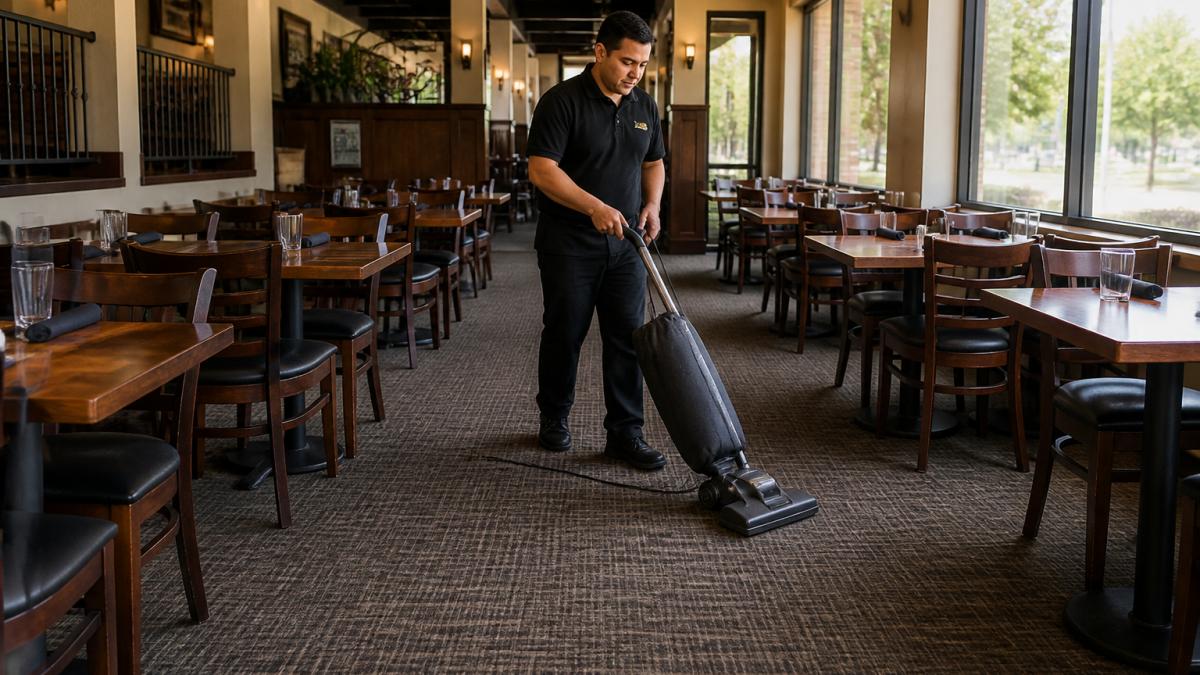
- Vacuum high-traffic paths (entryways, host stand, server stations) with a commercial upright on a high-pile setting.
- Spot clean any overnight stains with a carpet-safe product matched to the stain type.
- Check entry mats: a saturated mat stops working and starts tracking soil onto carpet.
Mid-Shift and Closing Tasks
- Respond to every food or drink spill within minutes, blotting from the outside in.
- Vacuum dining areas after the lunch rush and again after close, including under tables.
- Place wet-floor signs on any damp carpet and check drying time before reopening the area.
- Log completed tasks and flag anything the next shift or a professional team needs to handle.
Pro Tip
Vacuum high-traffic paths twice a day, not once. Most restaurant soil is dry grit that acts like sandpaper underfoot; removing it daily slows fiber wear more than any deep clean can reverse.
Vacuum high-traffic paths twice a day, not once. Most restaurant soil is dry grit that acts like sandpaper underfoot; removing it daily slows fiber wear more than any deep clean can reverse.
Restaurant Carpet Cleaning Checklist: Zones and Frequencies
A restaurant carpet cleaning checklist should assign every zone its own frequency, because an entryway and a back-of-house corridor do not get dirty at the same rate. Match the task to the traffic.
| Zone | Daily Task | Weekly Task | Frequency Note |
|---|---|---|---|
| Entry and vestibule | Vacuum and check mats | Deep spot clean edges | Highest soil load |
| Dining area | Vacuum after each rush | Move chairs, vacuum edges | High-traffic areas |
| Bar and server stations | Spot clean spills | Vacuum under stools | Sticky residue risk |
| Restroom corridor | Sweep and vacuum | Spot clean and deodorize | Moisture and tracked soil |
| Back of house | Sweep, vacuum walkways | Check for grease transfer | Kitchen grease risk |
| Storage area | Vacuum thresholds | Inspect for pests and damp | Low traffic, high risk |
Weekly tasks include edge vacuuming and a stain sweep. Monthly tasks include a condition review with a professional team. If you want a printable version, the restaurant carpet maintenance planner from Clean It Best breaks tasks into shift, daily, weekly, and monthly intervals, which pairs well with this zone table.
Restaurant Carpet Stain Removal: Spill Response by Stain Type
Restaurant carpet stain removal starts with one rule: blot, never rub, and always work from the outside of the stain inward. Rubbing pushes soil deeper into the fiber and spreads the stain. The second rule is speed. A spill handled in the first two minutes is a spot-clean; the same spill found at close is an extraction job.
Use this decision path for every spill during service:
- Stop and contain. Cordon the area with a wet-floor sign before anyone walks through it.
- Scoop solids. Lift food, ice, and garnish with a spoon or scraper. Do not press them into the pile.
- Blot liquids. Press a clean, white, colorfast cloth from the outside edge inward. Replace the cloth as it loads; a saturated cloth just redistributes soil.
- Match the treatment to the stain type using the table below.
- Rinse-blot with clean water, then dry with a fan or blotting towel before reopening the area.
- Log the spill with time, location, stain type, and product used so patterns show up over weeks.
| Stain type | First move | Treatment | Dwell time | Watch out for |
|---|---|---|---|---|
| Grease and cooking oil | Blot, then apply carpet-safe degreaser | Work in from edges; blot, do not scrub | 3-5 minutes | Hot water first sets grease into the fiber |
| Red wine and coffee | Blot immediately; do not rub | Mild detergent solution, then rinse-blot | 2-3 minutes | Letting it dry before treating locks in tannin color |
| Food spills (sauce, dressing) | Scoop solids, blot liquids | General spotter matched to the sauce base | 2-5 minutes | Oil-based dressings behave like grease, not like water |
| Tracked-in soil and mud | Let it dry fully, then vacuum | Spot clean only after dry soil is removed | None until dry | Wet mud smears and drives grit into the backing |
| Beverages (soda, juice, sports drinks) | Blot, then dilute with clean water | Mild detergent, rinse-blot | 1-2 minutes | Sugar residue re-soils fast if not rinsed |
| Service-animal accidents | Blot, then treat with an enzyme product | Enzyme spotter, allow full dwell, check odor after drying | 10-15 minutes | Masking with fragrance hides the problem without fixing it |
Three mechanisms explain most failures. Over-wetting: pouring solution directly onto carpet soaks the backing, causes delamination, and creates odor problems that lead to replacement, apply product to the cloth or a misting spray bottle, never a stream. Heat: hot water on grease or protein sets the stain; use warm water at most.
Watch Out
Never pour cleaning solution directly onto carpet. Over-wetting the backing causes delamination and odor, and it is one of the most common causes of carpet replacement in restaurants.
Never pour cleaning solution directly onto carpet. Over-wetting the backing causes delamination and odor, and it is one of the most common causes of carpet replacement in restaurants.
Test any spotter on a hidden area first. Colorfastness varies by dye lot, and a product that is safe on one dining room carpet can bleed color on another.
For a dried spill, re-wet it lightly with clean water, blot, then treat as above. Dried grease and dried sugar both need a short dwell before blotting. If a stain survives two treatment cycles, stop and flag it for professional extraction rather than escalating chemical strength during service.
Commercial Carpet Maintenance: Methods for Different Materials and Locations
Commercial carpet maintenance depends on the fiber and where it sits. Loop-pile handles foot traffic well but snags on chair legs; cut-pile feels softer but shows crushing under tables. Entry carpet needs the most aggressive vacuuming; back-of-house corridors need grease control.
Method matters too. Daily vacuuming handles dry soil. Spot cleaning handles spills. Periodic hot-water extraction handles the deep soil that vacuuming cannot reach, and the EPA’s guidance on indoor air quality and carpet notes that proper extraction and drying protect indoor air quality as much as appearance. That is where professional steam cleaning earns its place: it resets the carpet so the daily checklist can keep up.
Restaurant Cleaning Supplies for Daily Carpet Care
Restaurant cleaning supplies for carpet care should be few, labeled, and stored in one place so any shift can find them. A workable kit includes:
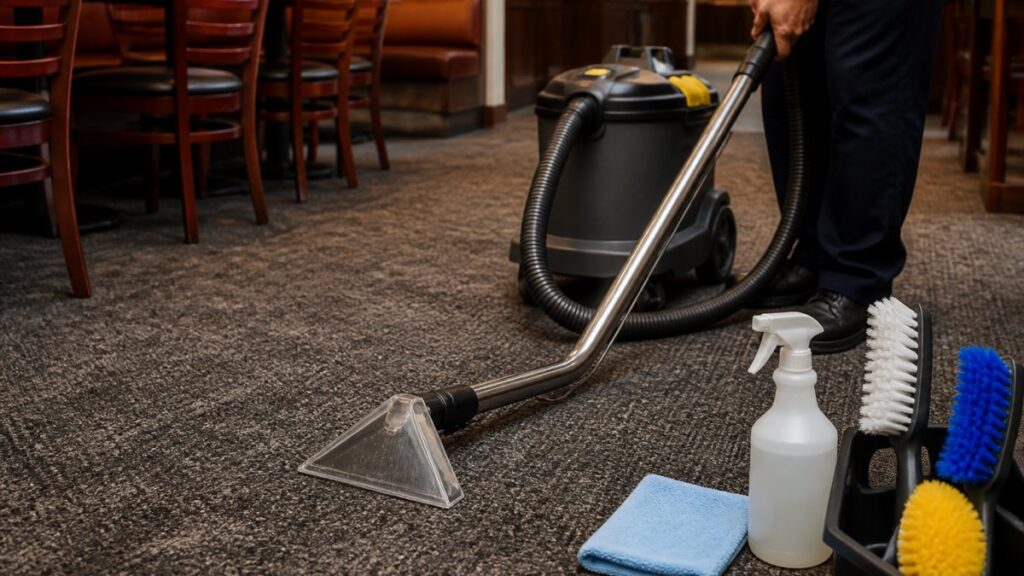
- A commercial upright vacuum with good filtration and a crevice tool
- A spot-cleaning kit with colorfast cloths and a soft brush
- Carpet-safe degreaser, mild detergent, and an enzyme spotter
- Wet-floor signs and a moisture meter or drying fan
- A laminated checklist and a maintenance log
Keep chemicals in a locked storage area, label every bottle, and train staff on dilution. Most supply mistakes are dilution mistakes.
Task Ownership, Handoff, and Verification
Task ownership is where most carpet checklists quietly fail. A checklist nobody signs is a wish list. The fix: one named owner per zone per shift, initials on sign-off, a two-minute handoff, and closing verification before the doors lock.
Assign roles, not just tasks. On a busy shift, four roles cover the carpet without adding headcount:
- Opening lead: walks every carpeted zone with lights fully on, logs stains, wet patches, and odors, and vacuums high-traffic paths.
- Server-station owner: owns the bar and server-station carpet, responds to spills within minutes, and places wet-floor signs.
- Dining-room closer: vacuums after the lunch rush and again after close, including under tables and along edges.
- Closing lead: verifies the log, checks drying areas, and signs off before lock-up.
Make the sign-off real. The log should have a row per zone per shift with columns for owner initials, time completed, and a flag column for anything the next shift or a professional team must handle.
Run a two-minute handoff. At shift change, the outgoing owner tells the incoming owner what was cleaned, what was flagged, and what still needs attention. Keep it verbal and short; the log carries the detail.
Verify with simple criteria, not opinions. The closing lead checks four things before signing off:
- High-traffic paths are visibly free of grit and debris.
- No wet carpet is left unmarked or unventilated.
- Every flag from the previous shift has a status: resolved, in progress, or escalated.
- The log is complete for every zone on the shift.
Use the log to find patterns. After two weeks, read the flags together.
Key Takeaway
The restaurant that signs its carpet checklist daily catches small problems while they are still cheap. The one that does not finds out about them when the carpet is being replaced.
The restaurant that signs its carpet checklist daily catches small problems while they are still cheap. The one that does not finds out about them when the carpet is being replaced.
Keep the log with the checklist, not in a manager’s office. If the closing lead has to hunt for it, verification gets skipped on the busiest nights.
Slip, Trip, and Drying-Time Controls
Floor safety is the part of carpet care that carries real liability. Wet carpet is a slip hazard, and the OSHA guidance on walking-working surfaces treats slips and trips as a leading cause of workplace injury. Control drying time deliberately.
- Place wet-floor signs on any damp carpet and keep guests out of the zone.
- Use fans to cut drying time, and check moisture before reopening an area.
- Keep cords and vacuum hoses out of walkways during service.
- Never leave a spot-cleaned area unmarked, even for a few minutes.
Pro Tip
Keep a small drying fan and two wet-floor signs in the same cupboard as the spot kit. If staff have to hunt for them, they will skip them.
Keep a small drying fan and two wet-floor signs in the same cupboard as the spot kit. If staff have to hunt for them, they will skip them.
Frequently Asked Questions
What carpet cleaning tasks should restaurants do every day?
Daily carpet maintenance for restaurants covers four basics: vacuum high-traffic zones before opening, spot-treat spills as they happen during service, do a full vacuum pass of dining and entry areas at closing, and log anything that needs follow-up. Entry mats and the path from the kitchen pass get the most attention because they collect tracked-in soil and grease first. A short daily routine keeps commercial carpet from grinding grit into the pile, which is what causes permanent wear.
How often should restaurant carpets be vacuumed?
High-traffic areas such as entryways, the host stand, and the path between the kitchen and dining room need vacuuming at least once a day, and often a quick pass mid-shift. Lower-traffic zones like private dining corners can be done every other day. The key is frequency matching foot traffic, not a fixed calendar. If you can see crumbs, lint, or dark lanes forming, the carpet is already past due for a pass.
How should restaurant staff clean up food and drink spills on carpet?
Blot, don’t rub. Scoop up solids first, then press a clean white cloth into the spill from the outside in. For food and drink spills, a mild dish-soap solution works for most cases; for grease, use a degreaser labeled safe for the carpet fiber. Always test in an inconspicuous spot and dry the area fully with a fan or blower before reopening the zone. Rubbing spreads the stain and pushes it deeper into the backing.
What supplies do staff need for daily carpet maintenance?
A working commercial vacuum with a HEPA filter, a set of clean white cloths, a carpet-safe spotter, a grease-specific degreaser, a spray bottle of water, a wet-floor sign, and a small fan or air mover for drying. Keep a spill kit on each floor so staff don’t have to hunt for supplies mid-service. Restocking the kit belongs on the closing checklist so it’s ready for the next shift.
When should a restaurant schedule professional carpet cleaning?
Most busy restaurants need professional hot-water extraction every three to six months, sooner if the carpet shows dark traffic lanes, lingering odors, or stains that come back after spot cleaning. High-volume dining rooms and restaurants with heavy grease in the air may need it quarterly. A professional cleaning also resets the carpet after months of daily vacuuming, which removes soil the vacuum can’t reach.


