
- 12
- 0
Table of Contents
- Why Carpet Cleaning Methods Matter in Assisted Living Facilities
- Low-Moisture Carpet Cleaning for Occupied Buildings
- Hot Water Extraction Carpet Cleaning: The Deep-Clean Standard
- How to Choose the Right Method: A Decision Guide
- Carpet Cleaning Frequency for Care Facilities
- Carpet Cleaning Between Residents and During Unit Turns
- Conclusion
- Frequently Asked Questions
Last Updated: October 19, 2026
Why Carpet Cleaning Methods Matter in Assisted Living Facilities
Carpet in an assisted living facility is not just flooring. It absorbs sound, cushions falls, and gives residents a sense of home.
Choosing the best carpet cleaning methods for assisted living facilities means balancing three things at once: deep soil removal, fast drying, and resident safety.
This guide breaks down the methods that work in occupied care buildings, when to use each one, and how to build a cleaning schedule your staff can actually follow.
Key Takeaway
The right method depends on occupancy, not just soil level. An occupied wing calls for a different approach than an empty unit turn.
The right method depends on occupancy, not just soil level. An occupied wing calls for a different approach than an empty unit turn.
Low-Moisture Carpet Cleaning for Occupied Buildings
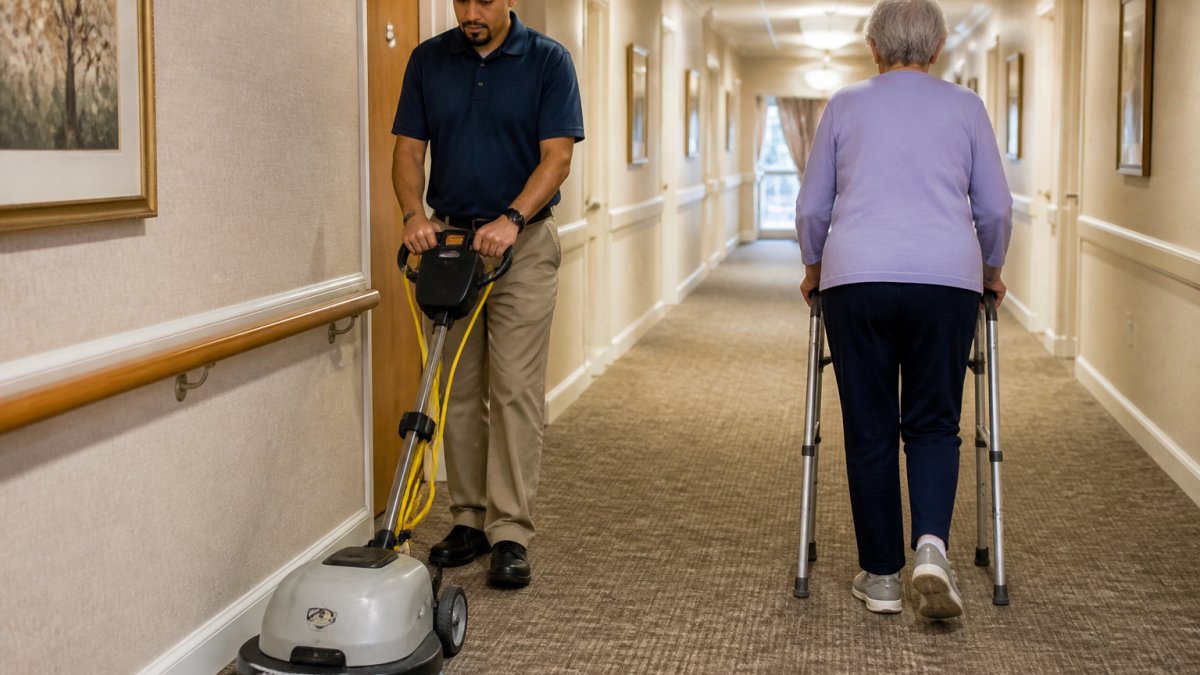
Low-moisture carpet cleaning is a method that uses minimal water and relies on mechanical action plus specialized products to lift soil from carpet fibers.
This is the workhorse method for occupied assisted living buildings. You can clean a common area in the morning and have residents walking on it within a couple of hours.
Encapsulation and Very Low Moisture Options
Encapsulation is a very low moisture cleaning method. A cleaning solution is worked into the carpet with a rotary or cylindrical brush machine.
Why this matters in a care facility:
- Water usage is low, so there is no carpet saturation
- Drying time is short, often under two hours
- Residents can stay in the area with minimal disruption
- It works well for interim cleaning between deep cleans
The Carpet and Rug Institute’s facility carpet care guidance recommends combining routine vacuuming with periodic deep cleaning.
One limit: encapsulation lifts surface and mid-level soil well, but it does not flush out deep embedded dirt the way extraction does.
Hot Water Extraction Carpet Cleaning: The Deep-Clean Standard
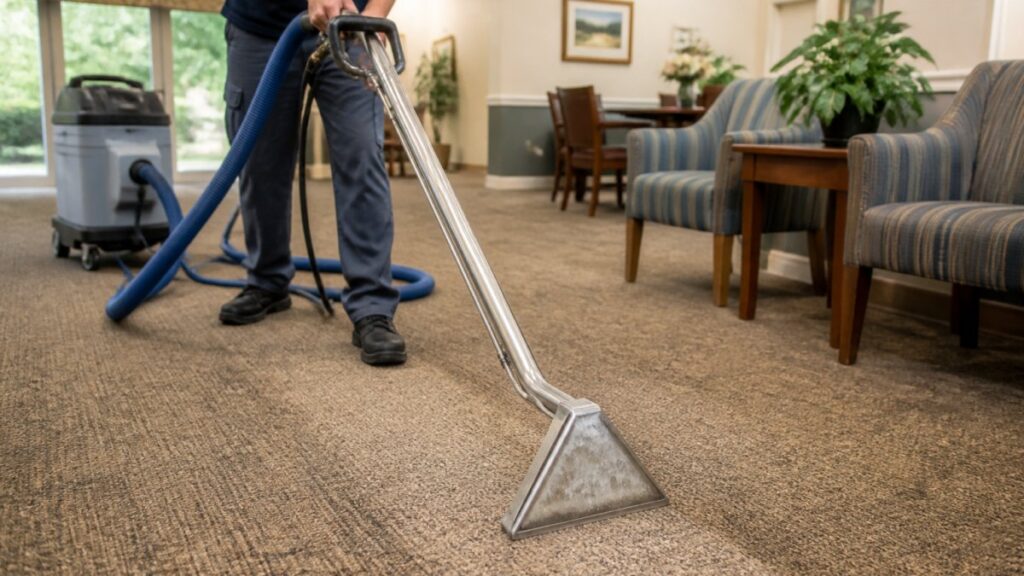
Hot water extraction, often called steam cleaning, is a deep cleaning method that injects heated water and cleaning solution into the carpet and immediately pulls it back out with strong vacuum pressure.
This is the restorative clean. When carpet looks gray in traffic areas or holds odors that spot treatment won’t fix, extraction is the answer.
A few practical points for care facilities:
- Schedule extraction during low-occupancy windows
- Allow for longer drying time, often several hours
- Use air movers to speed moisture control
- Confirm the technician extracts thoroughly, since leftover moisture invites problems
The Environmental Protection Agency’s indoor air quality guidance notes that carpet can trap dust and allergens, which is why deep extraction matters in buildings with vulnerable residents.
How to Choose the Right Method: A Decision Guide
Method selection comes down to four variables: soil level, carpet construction, how fast the space must return to service, and what infection-prevention precautions are active in that area. Most facility managers default to one method everywhere; the better approach is to match the method to the room and the occupancy window.
Score the space before you pick a method
Walk the area and rate it on three quick scales:
- Soil level: light (surface dust, no visible traffic lanes), moderate (gray traffic lanes, dull pile), heavy (dark lanes, matted pile, visible wicking at seams).
- Carpet type: loop pile and commercial glue-down tolerate low-moisture brushing well; cut pile and carpet with thick cushion hold more moisture and need longer dry windows after extraction.
- Service window: how many hours until residents, staff, or furniture return to the space.
Match the method to the score
| Soil level | Carpet type | Service window | Recommended method |
|---|---|---|---|
| Light | Any | Under 2 hours | Vacuum plus encapsulation |
| Moderate | Loop pile, glue-down | 2-4 hours | Encapsulation with brush agitation |
| Moderate | Cut pile, thick cushion | 4-8 hours | Low-moisture extraction with air movers |
| Heavy | Any | 8+ hours or empty | Hot water extraction |
| Heavy | Any | Under 4 hours | Interim encapsulation now, schedule extraction |
| Odor at source | Any | Any | Source treatment, then extraction |
The decision rules that matter in a care building
- If residents are in the space, the drying window drives the method, not the soil level. A heavy-soil corridor that must reopen in two hours gets encapsulation now and extraction on the next empty window. Trying to force extraction into a short window creates the slip hazard you were trying to avoid.
- If infection precautions are active in the area, confirm the method and chemistry with your infection-prevention lead before scheduling. Isolation precautions can restrict which chemicals, equipment, and staff traffic are allowed in a room, and some products require dwell times that conflict with a short service window.
- If the carpet is under warranty, check the manufacturer’s approved cleaning methods before using a new process. Many commercial carpet warranties specify extraction frequency and approved low-moisture systems; using an unapproved method can void coverage.
- If odor keeps returning after extraction, stop cleaning and investigate. Recurring odor usually means moisture or contamination in the backing, padding, or subfloor, a method problem won’t fix a source problem.
Pro Tip
Keep a one-page method-selection card at the environmental-services cart. Staff who spot a spill at 2 a.m. should not have to guess whether to blot, encapsulate, or call for extraction.
Keep a one-page method-selection card at the environmental-services cart. Staff who spot a spill at 2 a.m. should not have to guess whether to blot, encapsulate, or call for extraction.
Where each method fits in the rotation
Low-moisture and encapsulation are maintenance tools: they buy time between restorative cleans and keep traffic lanes presentable. Hot water extraction is the restorative reset that flushes embedded soil and resets the clock. A workable pattern is encapsulation on the interim cycle and extraction on the restorative cycle, with spot treatment in between. Skipping the interim step and relying only on extraction lets soil grind into the backing between visits, which shortens carpet life and makes each extraction less effective.
Key Takeaway
Pick the method by service window and occupancy first, soil level second, and carpet type third. That order keeps residents safe and still gets the carpet clean.
Pick the method by service window and occupancy first, soil level second, and carpet type third. That order keeps residents safe and still gets the carpet clean.
Carpet Cleaning Frequency for Care Facilities
Carpet cleaning frequency for care facilities depends on traffic and occupancy, but a workable baseline is daily vacuuming of high-traffic carpet, spot treatment as spills happen, interim low-moisture cleaning every few weeks, and deep extraction on a recurring schedule.
Many facilities find that traffic areas need attention far more often than resident rooms. A common approach is:
- Daily: vacuum traffic areas and entryways
- As needed: spot treatment for food spills and stains
- Monthly or so: interim encapsulation in busy corridors
- Quarterly or as soil demands: hot water extraction
Whittaker System’s nursing home cleaning guidance stresses a regular vacuuming schedule to stop dirt and debris from building up in carpet. Prevention is cheaper than restoration.
Watch Out
Skipping interim cleaning and relying only on annual extraction lets soil grind into carpet backing and padding. That shortens carpet lifespan and often forces early replacement.
Skipping interim cleaning and relying only on annual extraction lets soil grind into carpet backing and padding. That shortens carpet lifespan and often forces early replacement.
Carpet Cleaning Between Residents and During Unit Turns
A unit turn is not a bigger version of routine cleaning. It is a restorative clean with a hard deadline, an infection-control dimension, and a resident-safety handoff. The room has to be clean, dry, odor-free, and documented before the next resident moves in.
Coordinate with infection prevention before the turn starts
Carpet cleaning in a vacated room still falls under the facility’s infection-prevention policy. Before scheduling, confirm:
- Whether the room was under any isolation precaution and what terminal-cleaning steps are required before carpet work begins.
- Which cleaning chemicals are approved for use in resident-care areas, and whether the carpet product’s label directions and dwell time fit the turn schedule.
- Whether staff moving between the turned room and occupied areas need to follow specific traffic or PPE rules during the job.
A common pattern is to complete terminal cleaning of hard surfaces first, then run carpet cleaning, then do a final walkthrough. Doing carpet work first can redeposit soil or moisture on surfaces that were already cleaned.
The unit-turn cleaning sequence
- Strip and inspect. Remove linens and loose items, vacuum the full room including edges and under-bed zones, and note stains, odor, or damage.
- Treat sources first. Pet or incontinence odor, food stains, and spills need source treatment before any wet process, or extraction will spread the contamination.
- Extract the full room. Hot water extraction is the standard for turns because it flushes embedded soil and resets odor. Confirm the technician extracts thoroughly, leftover moisture in padding is what drives recurring odor.
- Dry to a measurable standard. Use air movers and confirm the carpet is dry to the touch and dry at the backing before furniture returns. Do not rely on elapsed time alone.
- Walkthrough and document. Record the method used, products applied, dry-down time, and any remaining condition issues.
Resident safety during drying and re-entry
Wet carpet is a slip hazard for residents using walkers, wheelchairs, or canes, and moisture can aggravate respiratory sensitivities. Practical controls:
- Keep the room closed to residents until the carpet is dry at the backing, not just dry on top.
- Ventilate the room during and after cleaning, and follow label directions for ventilation.
- Remove or secure loose rugs, cords, and furniture that could trip a resident during the turn.
- Confirm the room is odor-free and chemical residue is not present before the next resident moves in.
Chemical safety and product compatibility
Use products according to label directions, including dilution, dwell time, and ventilation. Confirm compatibility with the carpet backing, padding, and adhesive, especially in glue-down commercial installations where excess moisture can loosen adhesive. Keep chemicals stored away from resident areas and never leave mixed solutions unattended in an occupied wing.
Watch Out
A room that looks dry on the surface can still be wet at the backing. Reopening too early is the most common cause of recurring odor and slip complaints after a unit turn.
A room that looks dry on the surface can still be wet at the backing. Reopening too early is the most common cause of recurring odor and slip complaints after a unit turn.
Document the turn
Keep a simple turn log for each room: date, method, products, dry-down time, staff initials, and any condition issues flagged for maintenance. That log supports warranty claims, replacement decisions, and infection-prevention audits, and it gives the next shift a clear handoff.
Best For
Facilities that need unit turns completed quickly between residents, where fast drying, odor removal, and a documented safety handoff matter most.
Facilities that need unit turns completed quickly between residents, where fast drying, odor removal, and a documented safety handoff matter most.
Conclusion
Matching the right method to each space is the hardest part of carpet maintenance in a care facility, and getting it wrong costs you either resident safety or carpet lifespan. Stay Fresh Steam Cleaning helps assisted living and healthcare facilities in Bexar County keep carpets clean with certified, background-checked technicians, a satisfaction guarantee with a re-cleaning policy, and a full service range covering carpet, tile, and upholstery.
Frequently Asked Questions
What is the most effective way to clean carpets in an assisted living facility?
There is no single method that wins every time. For occupied hallways and common areas, low-moisture carpet cleaning with encapsulation lets you clean with minimal disruption and short dry times. For resident rooms and heavy soil, hot water extraction pulls embedded dirt and allergens from deep in the carpet fibers. Many facilities run both: low-moisture maintenance in high-traffic areas between residents, and scheduled hot water extraction for restorative deep cleans. The right mix depends on occupancy, carpet condition, and how much downtime each area can tolerate.
How often should carpets in assisted living facilities be professionally cleaned?
Most facilities benefit from deep cleaning high-traffic areas two to four times per year, with resident rooms and lower-traffic spaces cleaned at least once or twice a year. Interim low-moisture cleaning can fill the gaps every few weeks in entryways, dining rooms, and corridors. Carpet cleaning frequency for care facilities should also respond to real conditions: visible soiling, odors, spills, and unit turns. Build the schedule around occupancy patterns and document each cleaning so you can adjust based on how the carpet actually holds up.
Is steam cleaning or low-moisture carpet cleaning better for assisted living facilities?
Both have a place. Low-moisture carpet cleaning uses far less water, dries in a fraction of the time, and keeps hallways open, which matters when residents are moving through the building. Hot water extraction, often called steam cleaning, reaches deeper into carpet backing and padding to remove embedded soil and allergens. Use low-moisture methods for routine interim cleaning and occupied areas, and hot water extraction for periodic restorative cleaning. Pairing them gives you deep results without shutting down the facility.
How can a facility reduce slip risks while carpets are drying?
Drying time and moisture control are the core of resident safety during cleaning. Choose low-moisture methods for occupied areas so carpets are touch-dry quickly, and run air movers to speed drying after hot water extraction. Block off wet sections with cones or barriers, schedule cleaning when foot traffic is lowest, and tell staff which areas to avoid. Check carpet backing and padding before reopening a room, since surface dryness does not always mean the pad is dry. Document dry times so you can plan future cleanings around them.


