A commercial deep clean goes beyond routine upkeep, covering areas daily janitorial work skips: high-touch surfaces, restroom sanitation, floor care, carpet extraction, dusting, vacuuming, waste removal, and window cleaning.
A standard commercial deep clean covers:
High-touch surface cleaning: door handles, switches, shared keyboards
Restroom sanitation and disinfection protocols
Floor care, including carpet extraction and hard-surface scrubbing
Dusting and vacuuming of vents, ledges, and light fixtures
Waste removal and interior window cleaning
Upholstery cleaning for chairs, booths, and waiting-area seating
Top Professional Deep Cleaning Services for Small Businesses in San Antonio
The right deep cleaning provider depends on your space, schedule, and, most importantly, your industry’s compliance standards. A medical office, restaurant, and retail storefront have very different requirements, and a provider excellent for one may be a poor fit for another.
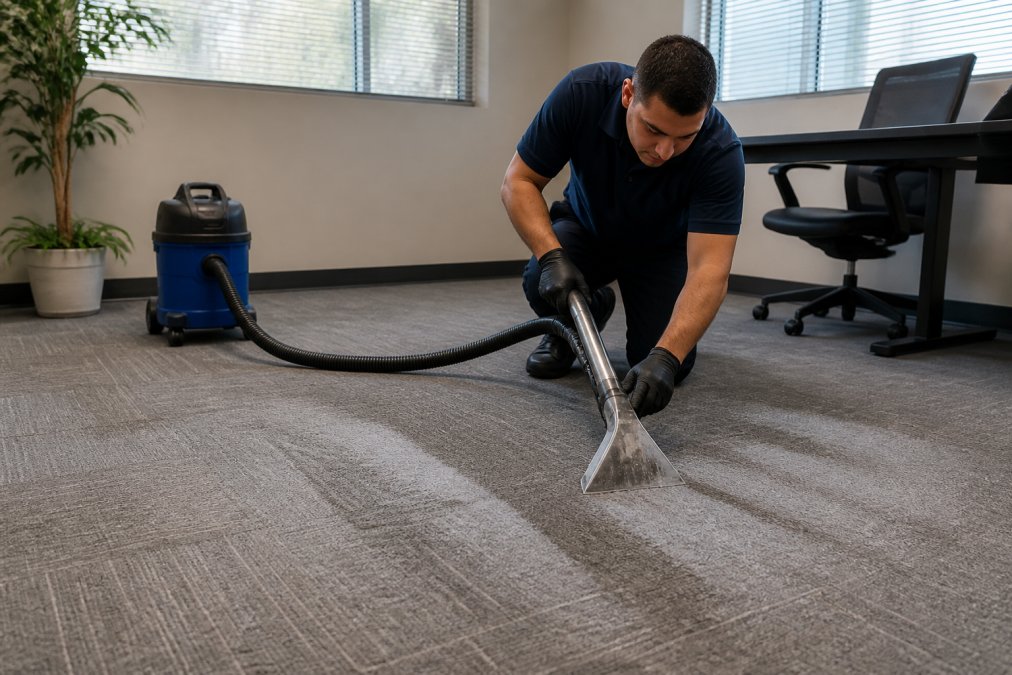
Cleaning technician using a steam cleaner on office carpet while a small business owner watches during deep cleaning services
Medical, dental, and clinical offices: Look for providers experienced with OSHA bloodborne pathogens standards (29 CFR 1910.1030) and EPA-registered disinfectants listed on List N or List G. Ask how they handle regulated medical waste versus general trash.
Food service and restaurants: Verify familiarity with FDA Food Code sanitation expectations and local health department inspection checklists. Grease, hood, and floor drain work is a different skill set than office cleaning.
Retail and customer-facing spaces: High-touch surface frequency, restroom traffic, and after-hours scheduling matter more than specialty disinfection.
Childcare and schools: Confirm the provider uses EPA-registered products and follows state childcare licensing sanitation rules.
General offices: Standard commercial deep cleaning with documented checklists is usually sufficient.
Stay Fresh Steam Cleaning
Stay Fresh Steam Cleaning is a family-owned and operated business serving businesses and homes across San Antonio and Bexar County. Its uniformed, drug-free, background-checked, and certified team matters when technicians work in your space after hours.
Carpet Cleaning in San Antonio, TX – Stay Fresh Steam Cleaning
Texas OCD Cleaners
Texas OCD Cleaners provides residential, commercial, and industrial deep cleaning with customized plans built around industry needs. Pricing is project-based; contact them directly for a quote.
Pros: Industrial-grade cleaning capability; scales across business sizes.
Cons: No standardized online pricing.
Vanguard Cleaning Systems
Vanguard Cleaning Systems runs a janitorial franchise network with standardized quality and weekday scheduling, built around recurring maintenance rather than one-off deep cleans.
Best for: Offices that need dependable, recurring janitorial service.
Pros: Franchise-backed consistency; established business hours for coordination.
SERVPRO of East San Antonio
SERVPRO handles heavy-duty deep cleaning, sanitation, and restoration for commercial facilities, the pick when a job involves biohazard remediation, water damage follow-up, or post-incident sanitation.
Best for: Businesses needing specialized sanitation or post-incident cleanup.
Pros: Deep expertise in restoration and sanitation.
Cons: Typically costs more than standard janitorial providers.
Commercial & Residential Restoration Services Near You | SERVPRO
Devhin’s Cleaning
Devhin’s Cleaning focuses on detailed workspace and common-area disinfection with punctual delivery.
Best for: Small offices that want punctual, detail-focused disinfection.
Pros: Highly rated for punctuality; workspace disinfection specialty.
Cons: Availability can be tight during peak demand.
Lupe’s Home & Office Cleaning
Lupe’s offers deep cleaning packages plus move-in and move-out services. Scheduling runs through call or text.
Pros: Transparent pricing; easy scheduling.
Pro Tip If your business is in a regulated category, healthcare, food service, childcare, ask each provider for a written statement of which disinfectants they use and whether those products appear on the EPA’s registered antimicrobial list. A provider who can’t answer that in writing is a compliance risk, not a bargain.
Commercial Office Cleaning Cost: Pricing Factors for Small Businesses
Commercial office cleaning cost depends on square footage, service frequency, and specialization. There’s no single rate, and any provider quoting one number before seeing your space is guessing.
The factors that move your quote most:
Pricing Factor
What It Changes
Typical Impact
Square footage
Total labor hours needed
Larger spaces cost more per visit
Service frequency
Recurring vs. one-time deep clean
Recurring visits lower the per-visit rate
Surface mix
Carpet, tile, hardwood, upholstery
Specialty surfaces add time and equipment
Occupancy
Cluttered vs. clear workspace
Heavy clutter slows every task
Add-ons
Windows, vents, restroom detail
Each add-on raises the total
Timing
After-hours or weekend work
Off-hours scheduling often costs more
Pro Tip Ask whether the quote includes carpet extraction or just vacuuming. Many low bids cover vacuuming only, which is why carpets look clean for two weeks and then look dirty again.
How to Hire a Commercial Cleaning Service
Hiring a commercial cleaning service comes down to four phases: define your scope, verify insurance and credentials, compare quotes on equal terms, then lock the terms in writing. Skip one and you’ll be comparing apples to oranges, or signing a contract that leaves you exposed.
Phase 1: Define your scope in writing
Write your scope first. List every surface and room you want covered. Include frequency, preferred hours, and any industry-specific requirements (EPA-registered disinfectants, OSHA-compliant handling, health department checklists).
Request three quotes using the same scope. Identical scopes make pricing comparable. If a provider wants to change the scope, note it, that’s a negotiating point, not a red flag by itself.
Phase 2: Verify insurance, credentials, and staff
Ask for proof of insurance. A fully insured provider protects you if something is damaged or someone is injured on your property. Request three documents:
General liability insurance, covers third-party property damage and bodily injury. A certificate of insurance (COI) should come directly from the insurer, not the cleaning company.
Workers’ compensation insurance, required in most states once a company has employees. If a cleaner is injured in your building and the provider has no workers’ comp, your business can be exposed to a claim.
Commercial auto insurance, if the crew drives to your site in a company vehicle.
Confirm bonding. A surety bond covers theft by an employee. Ask for the bond number and the issuing surety company.
Confirm who actually does the work. Some companies subcontract, which changes accountability. Ask whether your technicians are direct employees or 1099 contractors, in writing.
Verify background screening. Ask what it covers: criminal background, identity verification, employment eligibility (Form I-9). “We screen our staff” isn’t the same as a documented, repeatable process.
Phase 3: Compare quotes on equal terms
Check references from similar businesses. A restaurant has different needs than an office. Ask for two references in your industry and call them.
Read the contract line by line. Look for:
Term and auto-renewal clauses, many commercial contracts auto-renew for 12 months unless you give 30-60 days’ notice.
Price escalation clauses, how much can the rate rise, and how often?
Cancellation and rescheduling terms, what’s the notice window, and is there a fee?
Liability caps, some contracts limit the provider’s liability to the value of a single visit.
Indemnification language, who pays if a technician damages your equipment or a customer slips on a wet floor?
Phase 4: Start with a trial
Start with a one-time deep clean. Use it as a trial before committing to recurring service, it tells you more about reliability and quality than any sales call.
Watch Out Verbal promises about insurance mean nothing. Ask the insurer to email the certificate directly. If a provider can’t produce one, you carry the risk of any damage or injury on your property, and in a regulated industry, an uninsured or improperly trained crew can also put your own compliance standing at risk.
Key Takeaway The cheapest quote is rarely the cheapest outcome. A provider who is fully insured, bonded, and willing to put scope and liability terms in writing is worth more than a low bid that leaves you holding the risk.
Vetting Checklist: What to Verify Before You Sign
Before signing, verify six things: insurance, bonding, staff screening, equipment, references, and cancellation terms. Any provider who resists these questions is telling you what the working relationship will feel like.
General liability insurance, with a certificate sent directly from the insurer
Bonded professionals, so you’re covered if something goes missing
Background-checked staff, confirmed in writing
Commercial-grade equipment, not residential gear
At least two references from businesses your size
A written scope that lists exactly what’s included and excluded
Clear cancellation and rescheduling terms
Contract-free or short-term options, if you want flexibility
Deep Cleaning vs. Routine Janitorial Services
Deep cleaning and routine janitorial services solve different problems. Routine janitorial keeps a space presentable day to day; deep cleaning resets it. You need both, at different frequencies.
Routine Janitorial
Deep Cleaning
Frequency
Daily to weekly
Quarterly to annually
Focus
Appearance and hygiene
Buildup and restoration
Equipment
Standard tools
Commercial-grade extractors
Best for
Ongoing upkeep
Seasonal resets, move-ins
The ROI of Professional Deep Cleaning for Small Businesses
The return on professional deep cleaning shows up in three places: longer surface life, fewer sick days, and a better first impression. None land on a single invoice line, which is why the ROI gets overlooked.
Key Takeaway Deep cleaning isn’t a cost center. It’s preventative maintenance for your floors, your furniture, and your staff’s health, and it often costs less than the replacement it delays.
Frequently Asked Questions
How much should I expect to pay for a deep clean?
Pricing depends on square footage, service frequency, and specific tasks. For an accurate quote, contact providers directly and request a walkthrough. Many offer free estimates and can tailor a customized cleaning plan to your budget.
What is typically included in a deep clean?
A deep clean includes high-touch surface cleaning, restroom sanitation, floor care (including carpet extraction), dusting and vacuuming, waste removal, and window cleaning. Many services also offer disinfection protocols and eco-friendly products. For a full list, ask for a deep cleaning checklist from your provider. This ensures all areas are covered and you know exactly what to expect.
How often should a small business schedule a deep cleaning?
Most small businesses benefit from a deep clean quarterly, with routine janitorial services in between. High-traffic or industry-specific settings like restaurants or healthcare facilities may need monthly deep cleans. Consider your foot traffic, occupancy, and compliance requirements. A customized cleaning plan can set the right service frequency for your workplace hygiene.
What certifications should I look for in a commercial cleaning company?
Look for certified staff, background-checked technicians, and proof of insurance (fully insured and bonded). Industry certifications like IICRC for carpet cleaning or GBAC for infectious disease control add credibility. Also check for a satisfaction guarantee and a re-cleaning policy. These signals indicate a professional, reliable service that prioritizes customer satisfaction and workplace safety.
Are there tax benefits for hiring professional cleaning services?
Yes, for businesses, cleaning services are typically tax-deductible as a necessary business expense. This includes deep cleaning, janitorial services, and commercial sanitization. Consult your tax advisor to confirm eligibility based on your business structure. Keep detailed invoices and records. This can effectively reduce the net cost of maintaining a clean and healthy business environment.
What makes Cleanmate trusted above other cleaning service providers? When you combine higher standards, smarter strategies and superior quality all in one package, the result is top notch.